



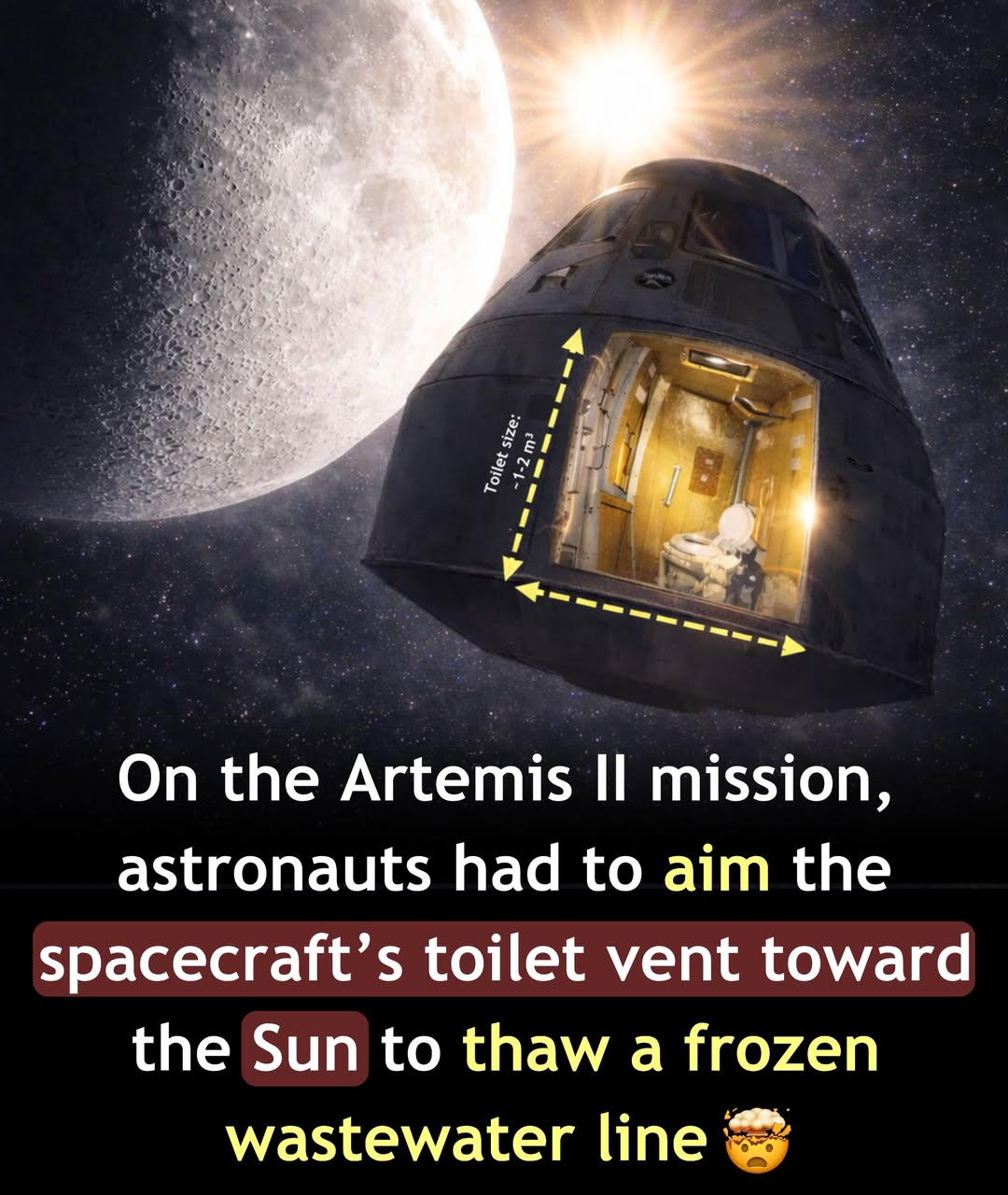
During the Artemis II mission , astronauts faced an unusual yet very human problem—a malfunctioning space toilet aboard the Orion capsule. In the microgravity environment, even basic systems can behave unpredictably. The issue began when a wastewater vent line froze , causing a blockage that prevented waste from being expelled properly.
To solve the problem, the crew had to get creative . They carefully reoriented the spacecraft so the vent line faced the Sun , allowing natural heat to thaw the frozen section. At the same time, engineers on the ground activated onboard heaters to assist with the process. These combined efforts gradually restored partial functionality to the system.
However, the toilet wasn’t fully reliable during this time. As a backup, astronauts had to use urine collection bags when necessary—an uncomfortable but essential workaround in space.
This incident highlighted an important reality : even as missions aim for the Moon and beyond, small but critical systems like toilets remain complex to manage in space. It served as a reminder that human space exploration isn’t just about advanced technology, but also about solving everyday challenges in extraordinary conditions .
To solve the problem, the crew had to get creative . They carefully reoriented the spacecraft so the vent line faced the Sun , allowing natural heat to thaw the frozen section. At the same time, engineers on the ground activated onboard heaters to assist with the process. These combined efforts gradually restored partial functionality to the system.
However, the toilet wasn’t fully reliable during this time. As a backup, astronauts had to use urine collection bags when necessary—an uncomfortable but essential workaround in space.
This incident highlighted an important reality : even as missions aim for the Moon and beyond, small but critical systems like toilets remain complex to manage in space. It served as a reminder that human space exploration isn’t just about advanced technology, but also about solving everyday challenges in extraordinary conditions .
During the Artemis II mission , astronauts faced an unusual yet very human problem—a malfunctioning space toilet aboard the Orion capsule. In the microgravity environment, even basic systems can behave unpredictably. The issue began when a wastewater vent line froze , causing a blockage that prevented waste from being expelled properly.
To solve the problem, the crew had to get creative . They carefully reoriented the spacecraft so the vent line faced the Sun , allowing natural heat to thaw the frozen section. At the same time, engineers on the ground activated onboard heaters to assist with the process. These combined efforts gradually restored partial functionality to the system.
However, the toilet wasn’t fully reliable during this time. As a backup, astronauts had to use urine collection bags when necessary—an uncomfortable but essential workaround in space.
This incident highlighted an important reality : even as missions aim for the Moon and beyond, small but critical systems like toilets remain complex to manage in space. It served as a reminder that human space exploration isn’t just about advanced technology, but also about solving everyday challenges in extraordinary conditions .






 Language
 English
 VN
VN
 French
 Spanish
 Portuguese
 Deutsch
 Turkish
 Dutch
Dutch
 Russian
 Romaian
 Portuguese (Brazil)
 Greek
Greek
 Arabic