

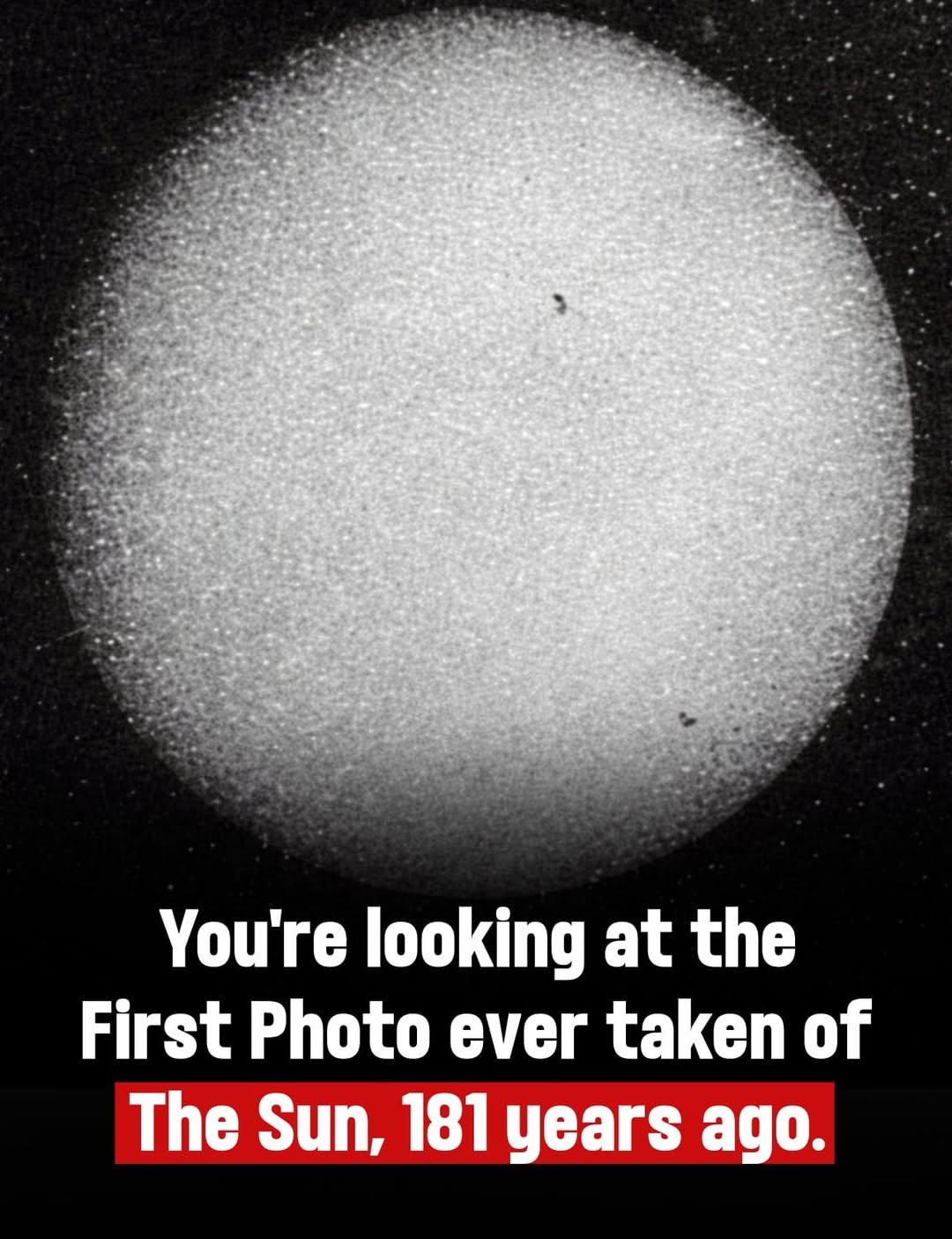
• On April 2, 1845, the first-ever photograph of the Sun was captured by French physicists Hippolyte Fizeau and Léon Foucault. Using an early photographic process called a daguerreotype, they produced a 12 cm image with an exposure time of just 1/60th of a second — a remarkable technical achievement for that era

    The image clearly revealed sunspots and the solar limb, offering one of the first visual records of activity on the Sun’s surface. At a time when photography itself was still in its infancy, this breakthrough marked a major step forward in both astronomy and imaging technology, opening the door to studying celestial objects in entirely new ways
    On April 2, 1845, the first-ever photograph of the Sun was captured by French physicists Hippolyte Fizeau and Léon Foucault. Using an early photographic process called a daguerreotype, they produced a 12 cm image with an exposure time of just 1/60th of a second — a remarkable technical achievement for that era The image clearly revealed sunspots and the solar limb, offering one of the first visual records of activity on the Sun’s surface. At a time when photography itself was still in its infancy, this breakthrough marked a major step forward in both astronomy and imaging technology, opening the door to studying celestial objects in entirely new ways
    Like
    Love
    Wow
    3
    0 Yorumlar 0 hisse senetleri 531 Views 0 önizleme
  • MARK YOUR CALENDARS!

    Tomorrow night, April 1st, the Pink Moon reaches peak illumination at 10:12 PM (ET) — and it’s not just any full moon…

    It’s the first full moon of spring.

    As flowers bloom and days grow longer, the night sky puts on one of the most symbolic shows of the year.

    The name “Pink Moon” comes from moss pink (creeping phlox) — one of the earliest wildflowers to bloom across North America.

    But different cultures saw it in their own beautiful way:

    Breaking Ice Moon (Algonquin)
    Moon When the Ducks Come Back (Lakota)
    Budding Moon (Tlingit)
    Rivers Flow Again (Dakota)

    All pointing to one thing:

    Renewal. Growth. Life returning.

    This is also the Paschal Moon, which helps determine Easter — making it one of the most important full moons of the year.

    And yes… it falls on April Fools’ Day this time

    Whether you see it as astronomy, tradition, or just a peaceful moment…

    Step outside tomorrow night.

    Look up.

    And take in a sky that quietly reminds us:

    Spring has arrived.
    MARK YOUR CALENDARS! Tomorrow night, April 1st, the Pink Moon reaches peak illumination at 10:12 PM (ET) — and it’s not just any full moon… It’s the first full moon of spring. As flowers bloom and days grow longer, the night sky puts on one of the most symbolic shows of the year. The name “Pink Moon” comes from moss pink (creeping phlox) — one of the earliest wildflowers to bloom across North America. But different cultures saw it in their own beautiful way: Breaking Ice Moon (Algonquin) Moon When the Ducks Come Back (Lakota) Budding Moon (Tlingit) Rivers Flow Again (Dakota) All pointing to one thing: Renewal. Growth. Life returning. This is also the Paschal Moon, which helps determine Easter — making it one of the most important full moons of the year. And yes… it falls on April Fools’ Day this time Whether you see it as astronomy, tradition, or just a peaceful moment… Step outside tomorrow night. Look up. And take in a sky that quietly reminds us: Spring has arrived.
    Like
    Love
    Wow
    3
    0 Yorumlar 0 hisse senetleri 662 Views 0 önizleme
  • Astronomers Just Found a Magnetar That Breaks All the Rules

    Magnetars are among the most extreme objects in the universe—ultra-dense neutron stars with magnetic fields trillions of times stronger than Earth’s. But a recent discovery is turning our understanding of their origins upside down.

    Using data from NASA’s Hubble and ESA’s Gaia space telescopes, scientists traced the motion of a magnetar named SGR 0501+4516—and what they found is shocking. Contrary to long-standing beliefs, this magnetar likely didn’t form from a typical core-collapse supernova.

    SGR 0501 sits near a known supernova remnant called HB9, and for years, scientists assumed the two were connected. But precision tracking shows the magnetar couldn’t have come from HB9—or any nearby supernova explosion.

    So where did it come from?

    Researchers propose a more exotic origin: a white dwarf that collapsed after feeding off a companion star, growing too massive and unstable. This alternative path could form a magnetar without any supernova at all.

    If confirmed, SGR 0501+4516 would be the strongest case yet for a magnetar formed through an unconventional route—forcing astronomers to rethink how these magnetic monsters are born and opening new doors in high-energy astrophysics.

    RESEARCH
    A.A. Chrimes et al., “The infrared counterpart and proper motion of magnetar SGR 0501+4516”, Astronomy & Astrophysics (2025)
    Astronomers Just Found a Magnetar That Breaks All the Rules Magnetars are among the most extreme objects in the universe—ultra-dense neutron stars with magnetic fields trillions of times stronger than Earth’s. But a recent discovery is turning our understanding of their origins upside down. Using data from NASA’s Hubble and ESA’s Gaia space telescopes, scientists traced the motion of a magnetar named SGR 0501+4516—and what they found is shocking. Contrary to long-standing beliefs, this magnetar likely didn’t form from a typical core-collapse supernova. SGR 0501 sits near a known supernova remnant called HB9, and for years, scientists assumed the two were connected. But precision tracking shows the magnetar couldn’t have come from HB9—or any nearby supernova explosion. So where did it come from? Researchers propose a more exotic origin: a white dwarf that collapsed after feeding off a companion star, growing too massive and unstable. This alternative path could form a magnetar without any supernova at all. If confirmed, SGR 0501+4516 would be the strongest case yet for a magnetar formed through an unconventional route—forcing astronomers to rethink how these magnetic monsters are born and opening new doors in high-energy astrophysics. RESEARCH A.A. Chrimes et al., “The infrared counterpart and proper motion of magnetar SGR 0501+4516”, Astronomy & Astrophysics (2025)
    Like
    Love
    Wow
    3
    0 Yorumlar 0 hisse senetleri 48K Views 0 önizleme
  • The first real images of a Martian sunset were captured by NASA’s Spirit and Opportunity rovers in the 2000s, and later more vividly by the Curiosity rover in 2015 and the Perseverance rover after 2021.

    The famous 2015 photo by Curiosity, which likely inspired this meme, shows the Sun setting on the Martian horizon with a bluish tint—a stark contrast to Earth’s red and orange hues.

    This bluish hue is caused by:

    Fine Martian dust scattering sunlight differently than Earth’s atmosphere does.

    Shorter blue wavelengths of light being scattered forward more efficiently in the thin, dusty Martian air.

    We are indeed the first humans to visually experience what a sunset looks like on another planet—not through artistic renditions or descriptions, but through direct photographic evidence sent back by interplanetary robots.

    This marks a profound moment in both astronomy and cultural history, expanding human perception beyond Earth.
    The first real images of a Martian sunset were captured by NASA’s Spirit and Opportunity rovers in the 2000s, and later more vividly by the Curiosity rover in 2015 and the Perseverance rover after 2021. The famous 2015 photo by Curiosity, which likely inspired this meme, shows the Sun setting on the Martian horizon with a bluish tint—a stark contrast to Earth’s red and orange hues. This bluish hue is caused by: Fine Martian dust scattering sunlight differently than Earth’s atmosphere does. Shorter blue wavelengths of light being scattered forward more efficiently in the thin, dusty Martian air. We are indeed the first humans to visually experience what a sunset looks like on another planet—not through artistic renditions or descriptions, but through direct photographic evidence sent back by interplanetary robots. This marks a profound moment in both astronomy and cultural history, expanding human perception beyond Earth.
    Like
    Love
    Wow
    3
    0 Yorumlar 0 hisse senetleri 40K Views 0 önizleme
  • China is pushing the frontiers of space science by constructing the world’s highest-altitude telescopes in Ngari Prefecture, Tibet, at a staggering elevation of 5,250 meters (17,224 feet) above sea level. These cutting-edge observatories aim to detect primordial gravitational waves—ripples in spacetime thought to be remnants of the Big Bang. The extreme altitude offers ideal conditions for astronomical observation, with minimal atmospheric interference and clear skies, putting it on par with premier sites like Chile’s Atacama Desert.

    A second telescope, Ngari No. 2, is already planned for an even more extreme elevation of 6,000 meters (19,685 feet), making it one of the loftiest scientific facilities on Earth. These installations will play a vital role in unraveling the mysteries of cosmic inflation, dark energy, and early universe physics. As China positions itself at the forefront of space exploration, these Tibetan telescopes symbolize a growing commitment to deep-universe observation and global scientific leadership.

    #ChinaSpace #TibetTelescopes #GravitationalWaves #AstronomyBreakthrough #BigBangResearch
    China is pushing the frontiers of space science by constructing the world’s highest-altitude telescopes in Ngari Prefecture, Tibet, at a staggering elevation of 5,250 meters (17,224 feet) above sea level. These cutting-edge observatories aim to detect primordial gravitational waves—ripples in spacetime thought to be remnants of the Big Bang. The extreme altitude offers ideal conditions for astronomical observation, with minimal atmospheric interference and clear skies, putting it on par with premier sites like Chile’s Atacama Desert. A second telescope, Ngari No. 2, is already planned for an even more extreme elevation of 6,000 meters (19,685 feet), making it one of the loftiest scientific facilities on Earth. These installations will play a vital role in unraveling the mysteries of cosmic inflation, dark energy, and early universe physics. As China positions itself at the forefront of space exploration, these Tibetan telescopes symbolize a growing commitment to deep-universe observation and global scientific leadership. #ChinaSpace #TibetTelescopes #GravitationalWaves #AstronomyBreakthrough #BigBangResearch
    Like
    Love
    Wow
    3
    0 Yorumlar 0 hisse senetleri 51K Views 0 önizleme
Arama Sonuçları