



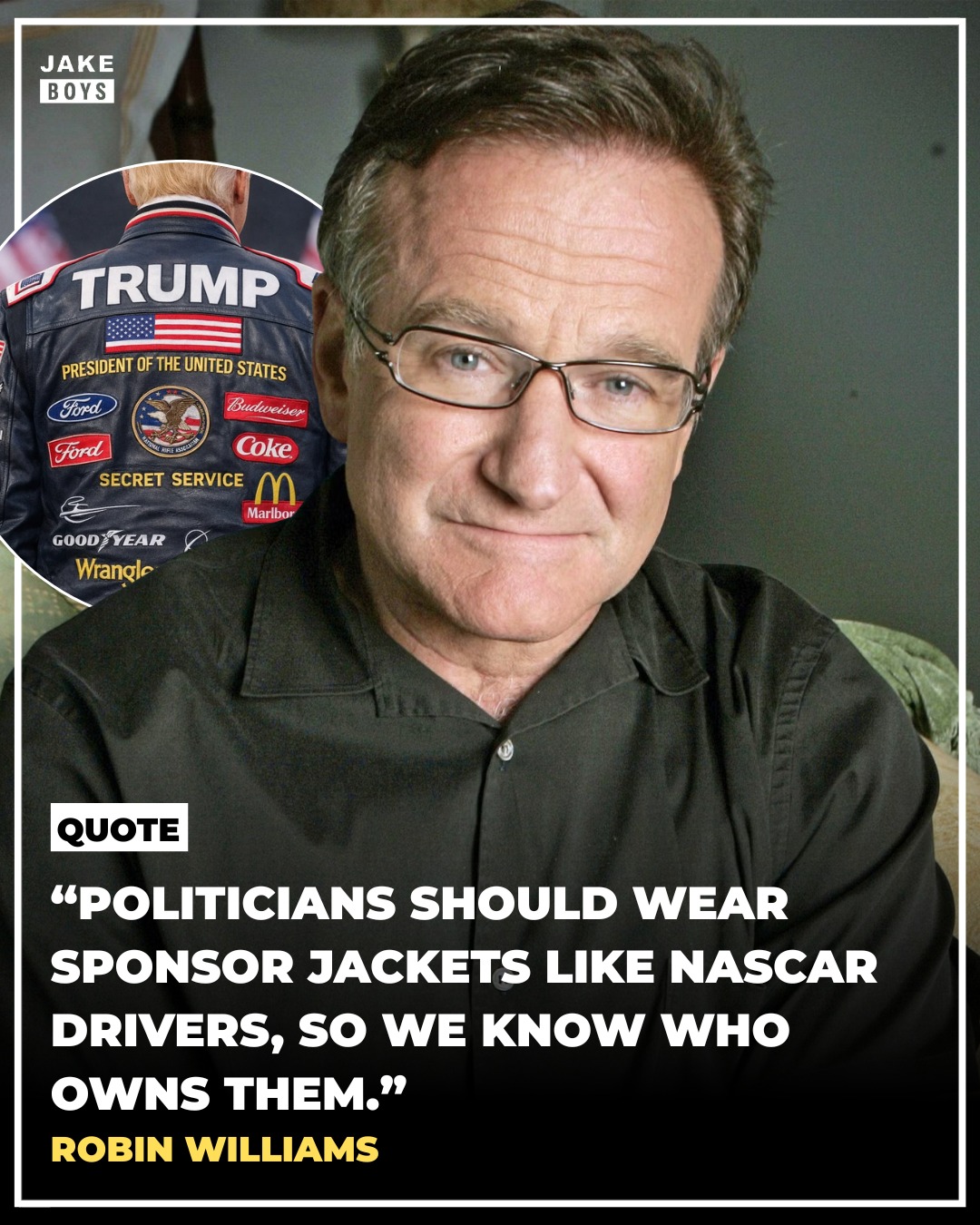
The late comedian Robin Williams offered a scathing satirical critique of the perceived influence of money in modern American politics through this analogy to NASCAR sponsorships. His statement suggests a belief that elected officials are beholden to and "owned" by wealthy donors and special interests who provide political funding, much like professional race car drivers are associated with the corporate brands that sponsor their vehicles.
Williams' comparison invokes the visual imagery of politicians wearing branded "sponsor jackets" to make their financial backers explicit and transparent to the public. This idea underscores the comedian's apparent perception that money has become a corrupting force in the democratic process, with elected representatives serving the interests of their financial supporters rather than the broader electorate.
By drawing this parallel to NASCAR, Williams taps into the widely recognized commercialization of that sport, where driver uniforms and race cars are plastered with corporate logos. Applying that same dynamic to the political realm reflects a cynical view that elected officials have become little more than mouthpieces for the highest bidders.
This statement reflects a longstanding debate around the role of money in politics and the degree to which it can distort the functioning of democratic institutions. Williams' sardonic proposal suggests a belief that greater transparency around the financial interests influencing politicians could help restore public trust and accountability.
Ultimately, this quote represents Williams' effort to call attention, through biting humor, to what he perceived as an unhealthy merger of wealth and political power that undermines the principles of representative government.
Williams' comparison invokes the visual imagery of politicians wearing branded "sponsor jackets" to make their financial backers explicit and transparent to the public. This idea underscores the comedian's apparent perception that money has become a corrupting force in the democratic process, with elected representatives serving the interests of their financial supporters rather than the broader electorate.
By drawing this parallel to NASCAR, Williams taps into the widely recognized commercialization of that sport, where driver uniforms and race cars are plastered with corporate logos. Applying that same dynamic to the political realm reflects a cynical view that elected officials have become little more than mouthpieces for the highest bidders.
This statement reflects a longstanding debate around the role of money in politics and the degree to which it can distort the functioning of democratic institutions. Williams' sardonic proposal suggests a belief that greater transparency around the financial interests influencing politicians could help restore public trust and accountability.
Ultimately, this quote represents Williams' effort to call attention, through biting humor, to what he perceived as an unhealthy merger of wealth and political power that undermines the principles of representative government.
The late comedian Robin Williams offered a scathing satirical critique of the perceived influence of money in modern American politics through this analogy to NASCAR sponsorships. His statement suggests a belief that elected officials are beholden to and "owned" by wealthy donors and special interests who provide political funding, much like professional race car drivers are associated with the corporate brands that sponsor their vehicles.
Williams' comparison invokes the visual imagery of politicians wearing branded "sponsor jackets" to make their financial backers explicit and transparent to the public. This idea underscores the comedian's apparent perception that money has become a corrupting force in the democratic process, with elected representatives serving the interests of their financial supporters rather than the broader electorate.
By drawing this parallel to NASCAR, Williams taps into the widely recognized commercialization of that sport, where driver uniforms and race cars are plastered with corporate logos. Applying that same dynamic to the political realm reflects a cynical view that elected officials have become little more than mouthpieces for the highest bidders.
This statement reflects a longstanding debate around the role of money in politics and the degree to which it can distort the functioning of democratic institutions. Williams' sardonic proposal suggests a belief that greater transparency around the financial interests influencing politicians could help restore public trust and accountability.
Ultimately, this quote represents Williams' effort to call attention, through biting humor, to what he perceived as an unhealthy merger of wealth and political power that undermines the principles of representative government.



 Language
 English
 VN
VN
 French
 Spanish
 Portuguese
 Deutsch
 Turkish
 Dutch
Dutch
 Russian
 Romaian
 Portuguese (Brazil)
 Greek
Greek
 Arabic