1 in 15.5 MILLION… and it just happened
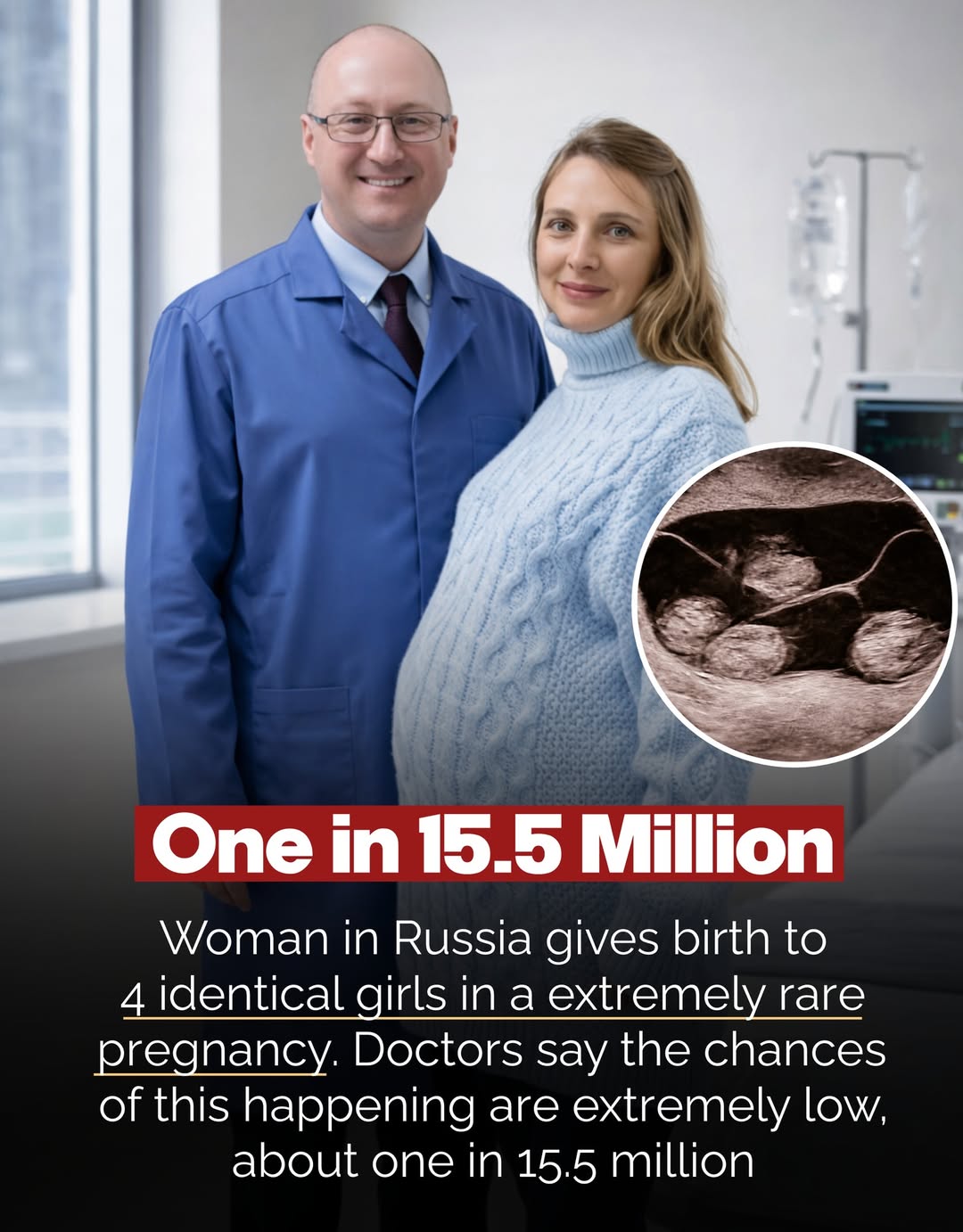
In St. Petersburg, Russia, a woman has given birth to four identical baby girls — an incredibly rare monochorionic quadruplet case.
All four babies came from a single fertilized egg that split multiple times… meaning they shared one placenta — making the pregnancy extremely high-risk.
The odds?
Around 1 in 15.5 million
This is also believed to be Russia’s first recorded case of identical quadruplets.
At birth:
1,360g
1,400g
1,570g
1,640g
Measuring between 37–41 cm, all four newborns are currently stable.
Globally, only about 15 similar cases have ever been documented — most involving girls, with no clear genetic explanation.
A rare moment where science, chance, and life come together in the most extraordinary way.
Four lives… from one beginning.
1 in 15.5 MILLION… and it just happened
In St. Petersburg, Russia, a woman has given birth to four identical baby girls — an incredibly rare monochorionic quadruplet case.
All four babies came from a single fertilized egg that split multiple times… meaning they shared one placenta — making the pregnancy extremely high-risk.
The odds?
Around 1 in 15.5 million
This is also believed to be Russia’s first recorded case of identical quadruplets.
At birth:
1,360g
1,400g
1,570g
1,640g
Measuring between 37–41 cm, all four newborns are currently stable.
Globally, only about 15 similar cases have ever been documented — most involving girls, with no clear genetic explanation.
A rare moment where science, chance, and life come together in the most extraordinary way.
Four lives… from one beginning.














 Language
 English
 VN
VN
 French
 Spanish
 Portuguese
 Deutsch
 Turkish
 Italiano
 Russian
 Romaian
 Portuguese (Brazil)
 Greek
Greek
 Arabic