


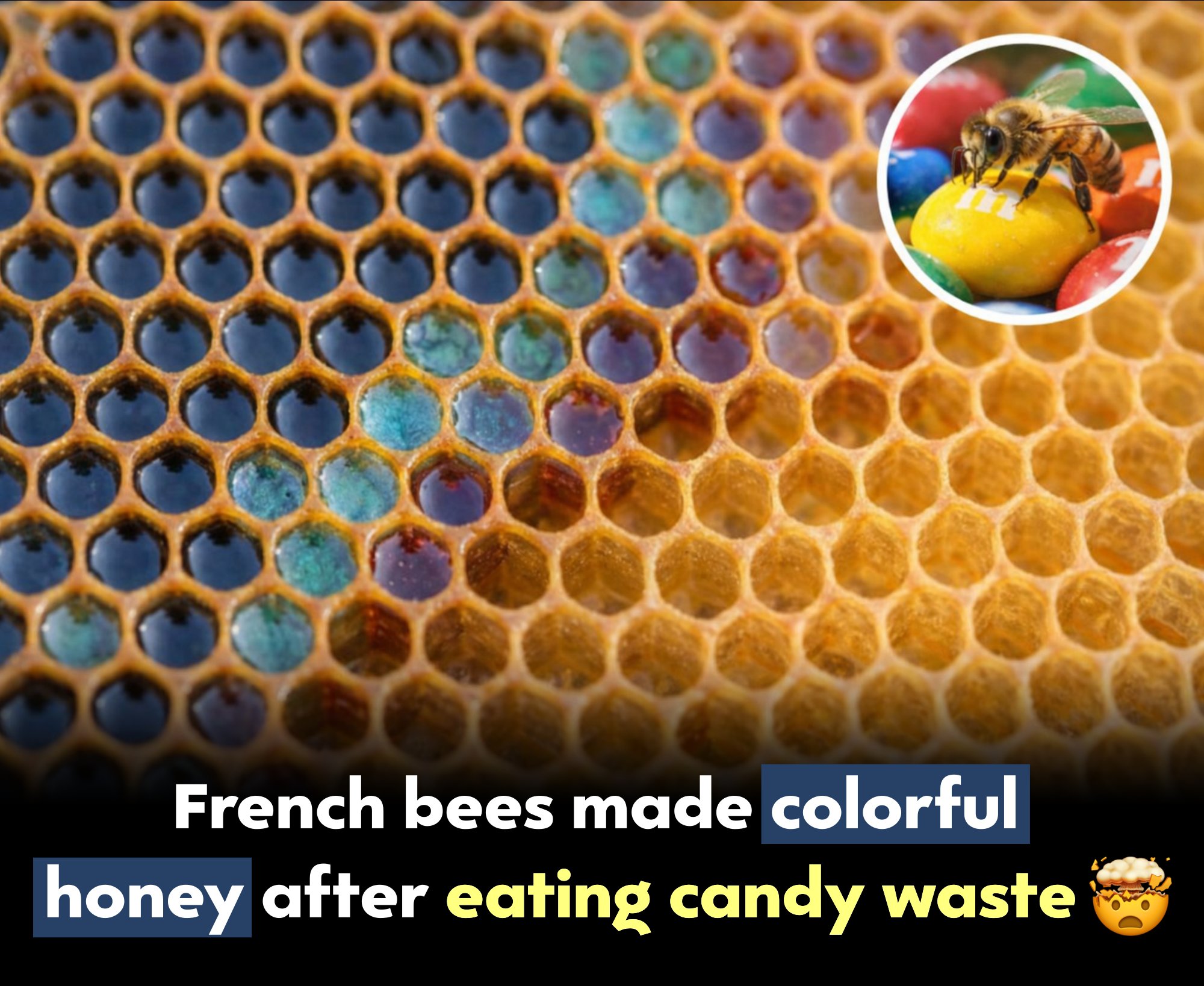
In a surprising incident in France, beekeepers opened their hives and were stunned to find honey tinted bright blue and green instead of the usual golden color . After some investigation, the unusual shades were traced back to a nearby candy factory. Bees had been collecting sugary residue from discarded M&M candies, and the vibrant food dyes made their way into the honey.
The situation showed how dependent bees are on nearby food sources . Instead of gathering nectar only from flowers, they chose an easy and abundant sugar supply. While the colorful honey seemed amusing at first, it also highlighted how human activities can influence nature in unexpected ways .
This discovery also demonstrated how adaptable bees are. When convenient food is available, they will collect from flowers, tree sap, or even processed sweets. For beekeepers, it was shocking, but it reinforced an important message: bees are vital for pollination and healthy ecosystems, so protecting them truly matters .
The situation showed how dependent bees are on nearby food sources . Instead of gathering nectar only from flowers, they chose an easy and abundant sugar supply. While the colorful honey seemed amusing at first, it also highlighted how human activities can influence nature in unexpected ways .
This discovery also demonstrated how adaptable bees are. When convenient food is available, they will collect from flowers, tree sap, or even processed sweets. For beekeepers, it was shocking, but it reinforced an important message: bees are vital for pollination and healthy ecosystems, so protecting them truly matters .
In a surprising incident in France, beekeepers opened their hives and were stunned to find honey tinted bright blue and green instead of the usual golden color . After some investigation, the unusual shades were traced back to a nearby candy factory. Bees had been collecting sugary residue from discarded M&M candies, and the vibrant food dyes made their way into the honey.
The situation showed how dependent bees are on nearby food sources . Instead of gathering nectar only from flowers, they chose an easy and abundant sugar supply. While the colorful honey seemed amusing at first, it also highlighted how human activities can influence nature in unexpected ways .
This discovery also demonstrated how adaptable bees are. When convenient food is available, they will collect from flowers, tree sap, or even processed sweets. For beekeepers, it was shocking, but it reinforced an important message: bees are vital for pollination and healthy ecosystems, so protecting them truly matters .


 Language
 English
 VN
VN
 French
 Portuguese
 Deutsch
 Turkish
 Dutch
Dutch
 Italiano
 Russian
 Romaian
 Portuguese (Brazil)
 Greek
Greek
 Arabic