


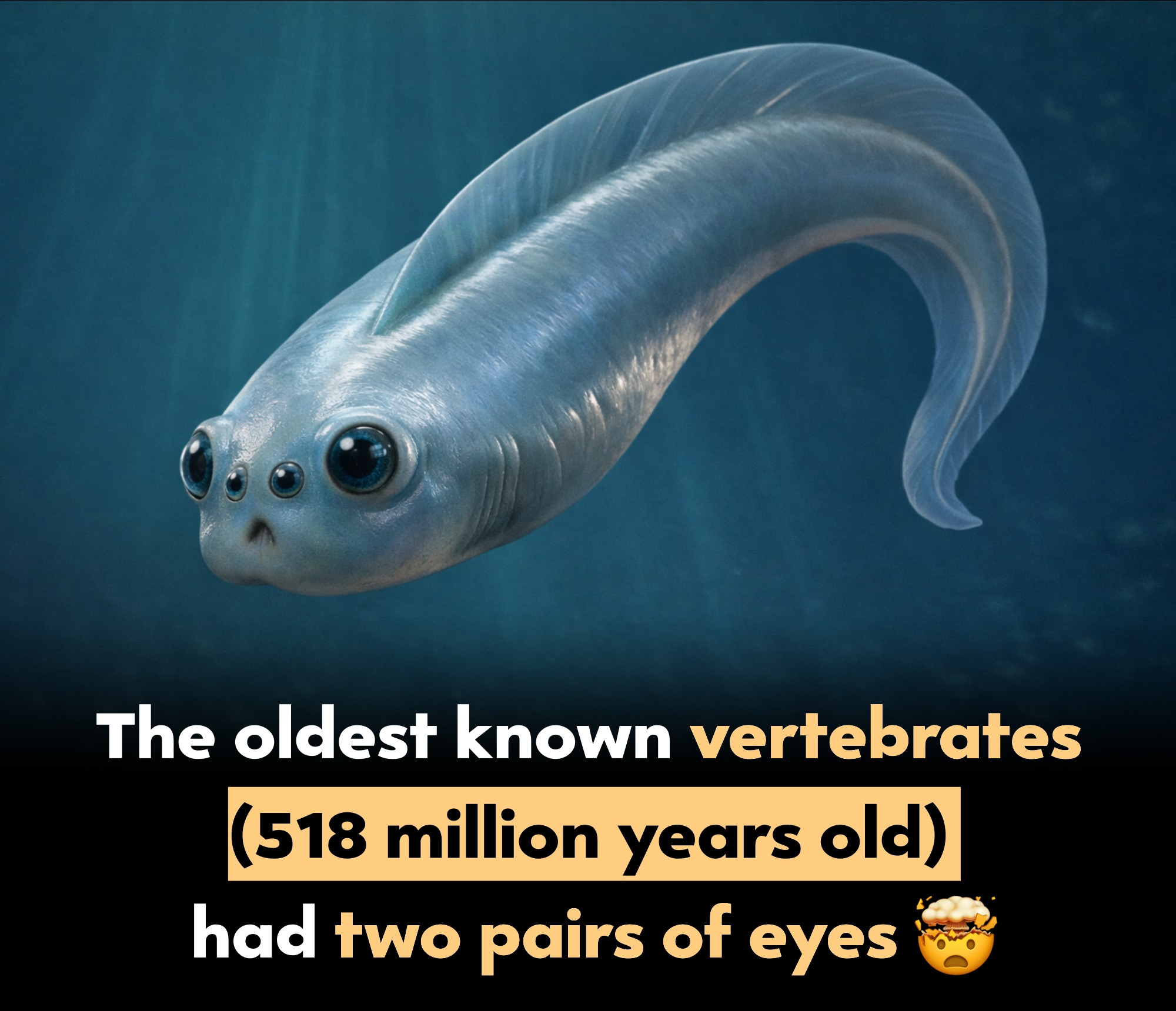
A groundbreaking study published in Nature reveals that some of the earliest known vertebrates — dating back around 518 million years — had two pairs of fully functional eyes
The fossils were discovered in China’s Kunming region and belong to early Cambrian jawless fish known as Myllokunmingids . Researchers identified preserved melanosomes and clear lens impressions, confirming that all four eyes were capable of forming images .
Scientists believe the extra pair of eyes gave these ancient vertebrates a wider field of vision, helping them detect predators in prehistoric oceans . Over millions of years, the upper pair is thought to have evolved into the pineal gland — the tiny structure in modern vertebrates that regulates sleep cycles and biological rhythms .
The fossils were discovered in China’s Kunming region and belong to early Cambrian jawless fish known as Myllokunmingids . Researchers identified preserved melanosomes and clear lens impressions, confirming that all four eyes were capable of forming images .
Scientists believe the extra pair of eyes gave these ancient vertebrates a wider field of vision, helping them detect predators in prehistoric oceans . Over millions of years, the upper pair is thought to have evolved into the pineal gland — the tiny structure in modern vertebrates that regulates sleep cycles and biological rhythms .
A groundbreaking study published in Nature reveals that some of the earliest known vertebrates — dating back around 518 million years — had two pairs of fully functional eyes
The fossils were discovered in China’s Kunming region and belong to early Cambrian jawless fish known as Myllokunmingids . Researchers identified preserved melanosomes and clear lens impressions, confirming that all four eyes were capable of forming images .
Scientists believe the extra pair of eyes gave these ancient vertebrates a wider field of vision, helping them detect predators in prehistoric oceans . Over millions of years, the upper pair is thought to have evolved into the pineal gland — the tiny structure in modern vertebrates that regulates sleep cycles and biological rhythms .


 Language
 English
 VN
VN
 French
 Spanish
 Portuguese
 Deutsch
 Dutch
Dutch
 Italiano
 Russian
 Romaian
 Portuguese (Brazil)
 Greek
Greek
 Arabic