


In a hyper-connected world, scientists once tried to recreate something purely human — a kiss.
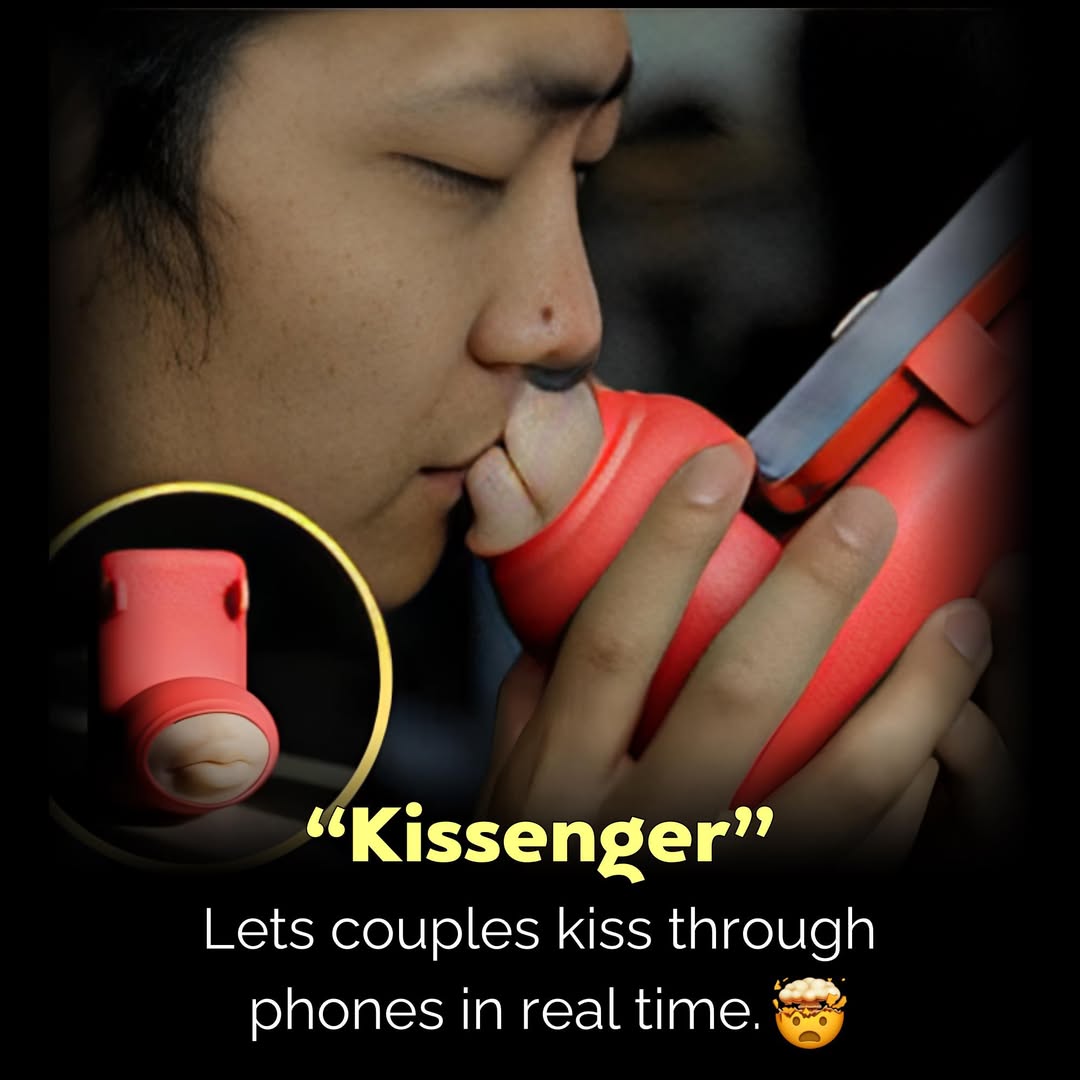
They developed a device called Kissenger (short for Kiss Messenger) for long-distance couples. The small gadget attached to a smartphone and used pressure sensors to detect the movement and intensity of a kiss. That data was instantly transmitted to a matching device, allowing the partner to feel it in real time.
It wasn’t science fiction, but a real experiment exploring whether technology could transmit emotion through touch — not just text, voice, or video. Researchers believed physical interaction plays a key role in bonding, and this was an attempt to bridge that emotional gap.
Although it never became mainstream, the idea sparked conversations about virtual intimacy and the future of relationships. Because sometimes, people don’t just want to hear “I miss you” — they want to feel it.
They developed a device called Kissenger (short for Kiss Messenger) for long-distance couples. The small gadget attached to a smartphone and used pressure sensors to detect the movement and intensity of a kiss. That data was instantly transmitted to a matching device, allowing the partner to feel it in real time.
It wasn’t science fiction, but a real experiment exploring whether technology could transmit emotion through touch — not just text, voice, or video. Researchers believed physical interaction plays a key role in bonding, and this was an attempt to bridge that emotional gap.
Although it never became mainstream, the idea sparked conversations about virtual intimacy and the future of relationships. Because sometimes, people don’t just want to hear “I miss you” — they want to feel it.
In a hyper-connected world, scientists once tried to recreate something purely human — a kiss.
They developed a device called Kissenger (short for Kiss Messenger) for long-distance couples. The small gadget attached to a smartphone and used pressure sensors to detect the movement and intensity of a kiss. That data was instantly transmitted to a matching device, allowing the partner to feel it in real time.
It wasn’t science fiction, but a real experiment exploring whether technology could transmit emotion through touch — not just text, voice, or video. Researchers believed physical interaction plays a key role in bonding, and this was an attempt to bridge that emotional gap.
Although it never became mainstream, the idea sparked conversations about virtual intimacy and the future of relationships. Because sometimes, people don’t just want to hear “I miss you” — they want to feel it.


 Language
 English
 VN
VN
 Spanish
 Portuguese
 Deutsch
 Turkish
 Dutch
Dutch
 Italiano
 Russian
 Romaian
 Portuguese (Brazil)
 Greek
Greek
 Arabic