


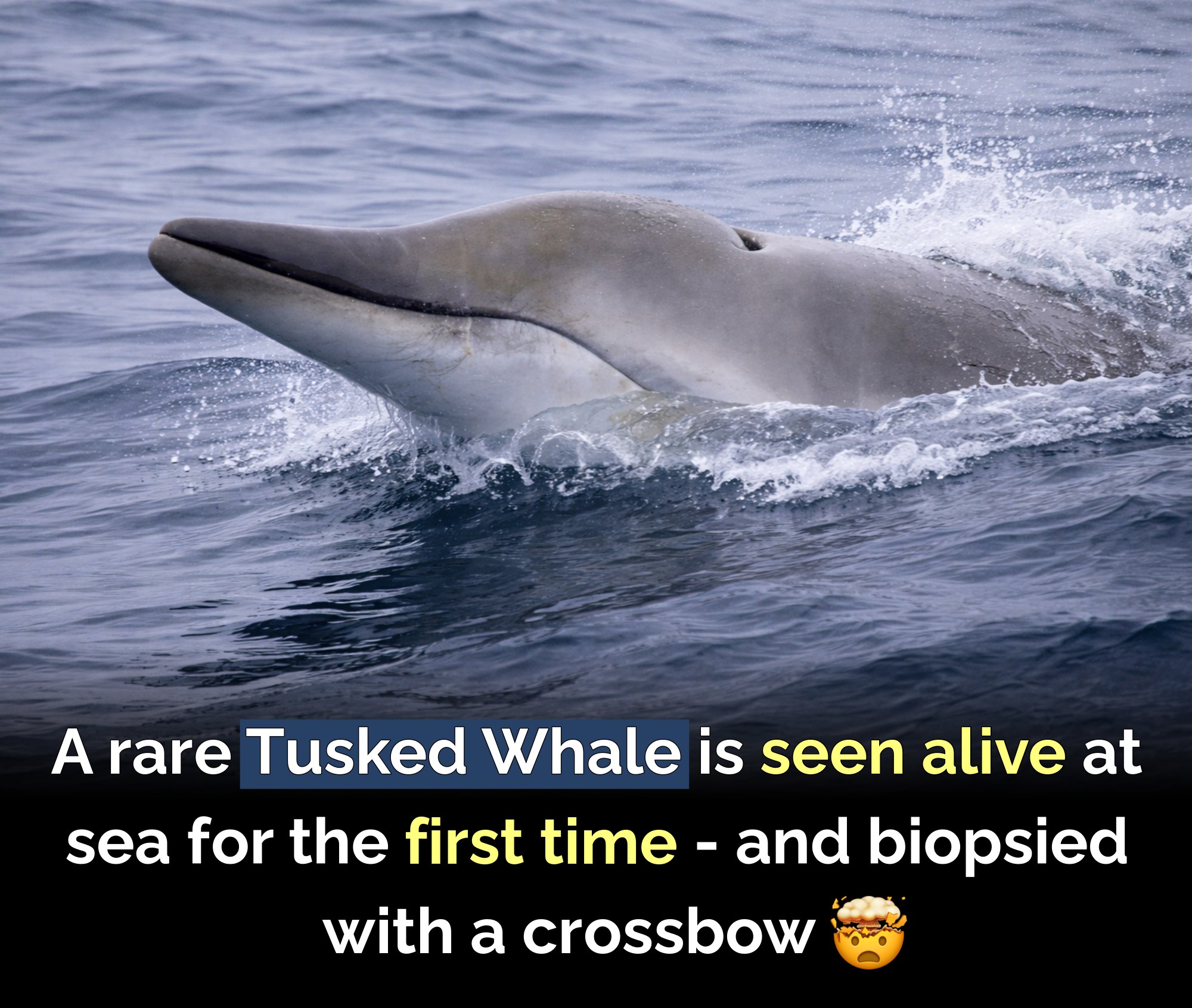
In a historic ocean discovery , scientists have finally observed a living ginkgo-toothed beaked whale in its natural habitat. For decades, this mysterious deep-sea species was known only from stranded carcasses washed ashore or rare accidental catches in fishing nets. Everything changed in June 2024 off Mexico’s Baja Peninsula , when researchers tracked a unique sonar signal to a small group of these elusive whales.
Using a specialized crossbow, the team safely collected a tiny skin biopsy for genetic testing, confirming the species’ identity for the first time ever in the wild . This breakthrough links the whale’s physical appearance to its distinct acoustic signature, allowing scientists to monitor it globally through underwater microphones .
Researchers also noted adult males with visible tusks and battle scars , likely from rivals and sharks . As one of the least understood large mammals on Earth , this sighting opens an exciting new chapter for marine research and conservation efforts.
Using a specialized crossbow, the team safely collected a tiny skin biopsy for genetic testing, confirming the species’ identity for the first time ever in the wild . This breakthrough links the whale’s physical appearance to its distinct acoustic signature, allowing scientists to monitor it globally through underwater microphones .
Researchers also noted adult males with visible tusks and battle scars , likely from rivals and sharks . As one of the least understood large mammals on Earth , this sighting opens an exciting new chapter for marine research and conservation efforts.
In a historic ocean discovery , scientists have finally observed a living ginkgo-toothed beaked whale in its natural habitat. For decades, this mysterious deep-sea species was known only from stranded carcasses washed ashore or rare accidental catches in fishing nets. Everything changed in June 2024 off Mexico’s Baja Peninsula , when researchers tracked a unique sonar signal to a small group of these elusive whales.
Using a specialized crossbow, the team safely collected a tiny skin biopsy for genetic testing, confirming the species’ identity for the first time ever in the wild . This breakthrough links the whale’s physical appearance to its distinct acoustic signature, allowing scientists to monitor it globally through underwater microphones .
Researchers also noted adult males with visible tusks and battle scars , likely from rivals and sharks . As one of the least understood large mammals on Earth , this sighting opens an exciting new chapter for marine research and conservation efforts.


 Language
 English
 VN
VN
 French
 Spanish
 Portuguese
 Turkish
 Dutch
Dutch
 Italiano
 Russian
 Romaian
 Portuguese (Brazil)
 Greek
Greek
 Arabic