


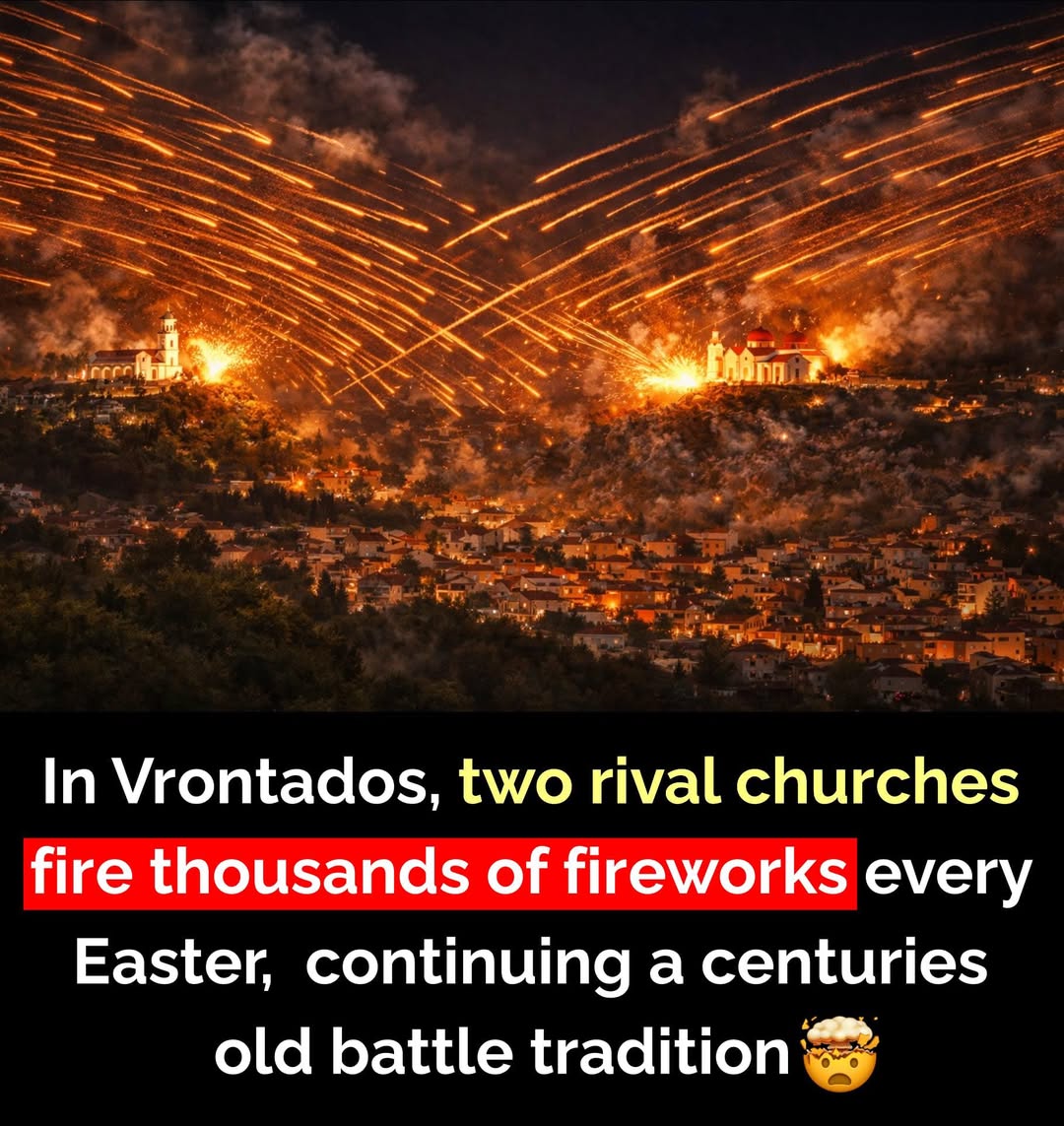
In Vrontados , two rival churches take part in one of the world’s most explosive traditions every Easter . Thousands of homemade fireworks are launched across the night sky as each side targets the other’s bell tower in a dramatic display of skill and rivalry.
This fiery battle isn’t random—it’s a centuries-old tradition believed to date back to the time of the Ottoman Empire, when real cannons were once used instead of fireworks . Over time, fireworks replaced the weapons, turning conflict into celebration.
Despite the intensity, the event is mostly symbolic. Both churches proudly claim victory every year, keeping the rivalry alive with no clear winner .
As the night ends, one thing is certain—the score is never settled. Instead, both sides agree to continue the tradition the following year, making it a never-ending spectacle of culture, history, and community spirit
This fiery battle isn’t random—it’s a centuries-old tradition believed to date back to the time of the Ottoman Empire, when real cannons were once used instead of fireworks . Over time, fireworks replaced the weapons, turning conflict into celebration.
Despite the intensity, the event is mostly symbolic. Both churches proudly claim victory every year, keeping the rivalry alive with no clear winner .
As the night ends, one thing is certain—the score is never settled. Instead, both sides agree to continue the tradition the following year, making it a never-ending spectacle of culture, history, and community spirit
In Vrontados , two rival churches take part in one of the world’s most explosive traditions every Easter . Thousands of homemade fireworks are launched across the night sky as each side targets the other’s bell tower in a dramatic display of skill and rivalry.
This fiery battle isn’t random—it’s a centuries-old tradition believed to date back to the time of the Ottoman Empire, when real cannons were once used instead of fireworks . Over time, fireworks replaced the weapons, turning conflict into celebration.
Despite the intensity, the event is mostly symbolic. Both churches proudly claim victory every year, keeping the rivalry alive with no clear winner .
As the night ends, one thing is certain—the score is never settled. Instead, both sides agree to continue the tradition the following year, making it a never-ending spectacle of culture, history, and community spirit


 Language
 VN
VN
 French
 Spanish
 Portuguese
 Deutsch
 Turkish
 Dutch
Dutch
 Italiano
 Russian
 Romaian
 Portuguese (Brazil)
 Greek
Greek
 Arabic