



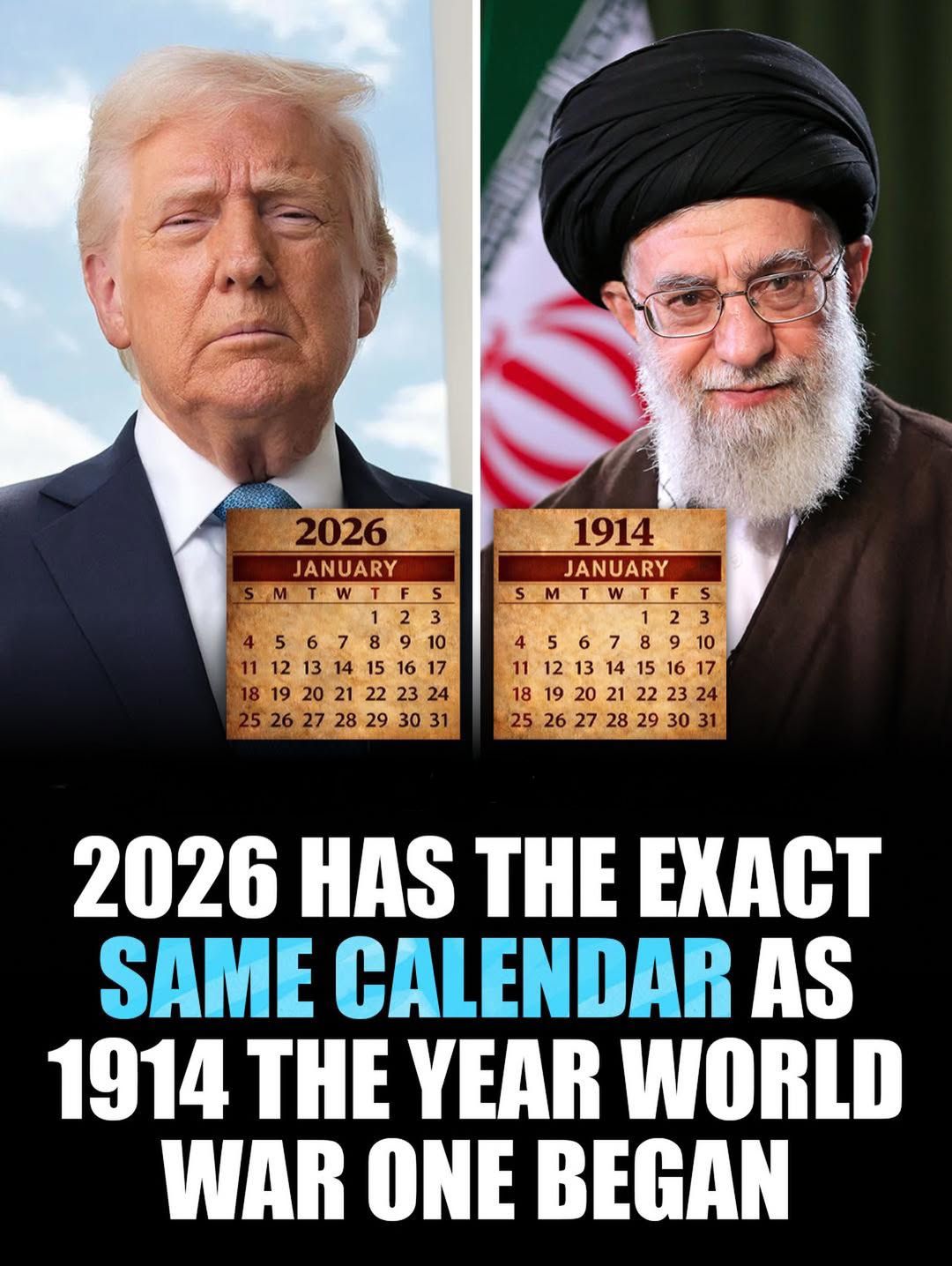
The calendar for 2026 is identical to the one used in 1914, meaning every date falls on the exact same day of the week. This happens because of the way the Gregorian calendar cycles work.
In most cases, calendars repeat every 28 years, but leap years and century rules can shift the pattern. Both 1914 and 2026 begin on a Thursday and are non-leap years, which makes their calendars line up perfectly.
Interestingly, 1914 was the year World War I began, after the assassination of Archduke Franz Ferdinand triggered a chain reaction of alliances that pulled much of the world into conflict.
While the matching calendars are simply a mathematical coincidence, it’s a reminder of how patterns in time can repeat across history.
Follow for more interesting facts
#HistoryFacts #DidYouKnow #CalendarFacts #History #WorldWarI #FunFacts
In most cases, calendars repeat every 28 years, but leap years and century rules can shift the pattern. Both 1914 and 2026 begin on a Thursday and are non-leap years, which makes their calendars line up perfectly.
Interestingly, 1914 was the year World War I began, after the assassination of Archduke Franz Ferdinand triggered a chain reaction of alliances that pulled much of the world into conflict.
While the matching calendars are simply a mathematical coincidence, it’s a reminder of how patterns in time can repeat across history.
Follow for more interesting facts
#HistoryFacts #DidYouKnow #CalendarFacts #History #WorldWarI #FunFacts
The calendar for 2026 is identical to the one used in 1914, meaning every date falls on the exact same day of the week. This happens because of the way the Gregorian calendar cycles work.
In most cases, calendars repeat every 28 years, but leap years and century rules can shift the pattern. Both 1914 and 2026 begin on a Thursday and are non-leap years, which makes their calendars line up perfectly.
Interestingly, 1914 was the year World War I began, after the assassination of Archduke Franz Ferdinand triggered a chain reaction of alliances that pulled much of the world into conflict.
While the matching calendars are simply a mathematical coincidence, it’s a reminder of how patterns in time can repeat across history.
Follow for more interesting facts
#HistoryFacts #DidYouKnow #CalendarFacts #History #WorldWarI #FunFacts


 Language
 English
 VN
VN
 French
 Spanish
 Portuguese
 Deutsch
 Turkish
 Dutch
Dutch
 Italiano
 Romaian
 Portuguese (Brazil)
 Greek
Greek
 Arabic