
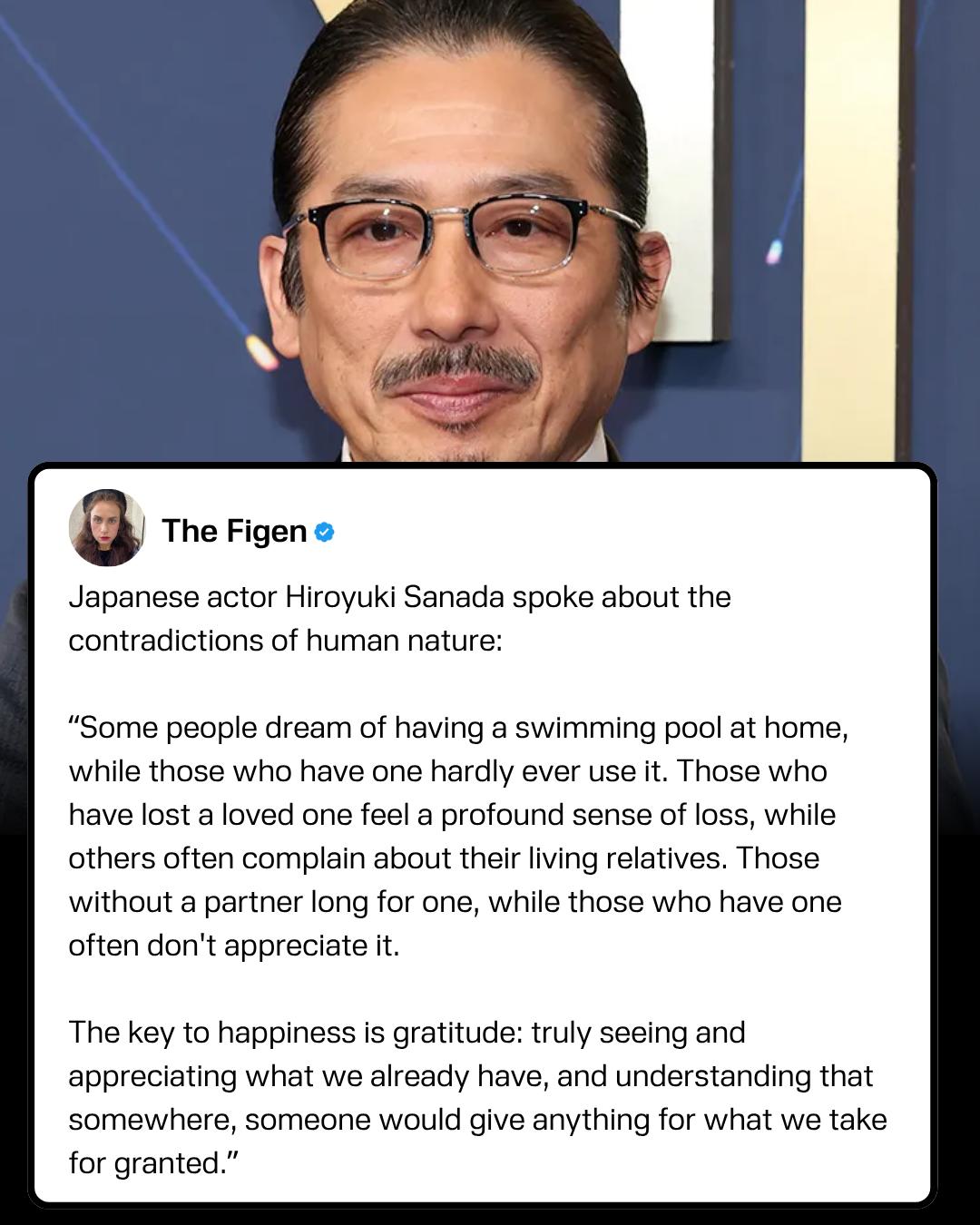
• Japanese actor Hiroyuki Sanada went viral after talking about the weird contradictions in human nature.

    Here is the full statement.

    “Some people dream of having a swimming pool at home, while those who have one hardly ever use it.

    Those who have lost a loved one feel a profound sense of loss, while others often complain about their living relatives.

    Those without a partner long for one, while those who have one often don't appreciate it.

    The hungry would give anything for a meal, while the satiated complain about the taste of their food.

    Those without a car dream of owning one, while those who have a car are always looking for a better one.”

    The key to happiness is gratitude: truly seeing and appreciating what we already have, and understanding that somewhere, someone would give anything for what we take for granted.
    Japanese actor Hiroyuki Sanada went viral after talking about the weird contradictions in human nature. Here is the full statement. “Some people dream of having a swimming pool at home, while those who have one hardly ever use it. Those who have lost a loved one feel a profound sense of loss, while others often complain about their living relatives. Those without a partner long for one, while those who have one often don't appreciate it. The hungry would give anything for a meal, while the satiated complain about the taste of their food. Those without a car dream of owning one, while those who have a car are always looking for a better one.” The key to happiness is gratitude: truly seeing and appreciating what we already have, and understanding that somewhere, someone would give anything for what we take for granted.
    Like
    Love
    Wow
    3
    0 Комментарии 0 Поделились 94 Просмотры 0 предпросмотр
  • The Japanese are years ahead of us in ice cream sandwich technology
    The Japanese are years ahead of us in ice cream sandwich technology
    Like
    Love
    Wow
    3
    0 Комментарии 0 Поделились 142Кб Просмотры 0 предпросмотр
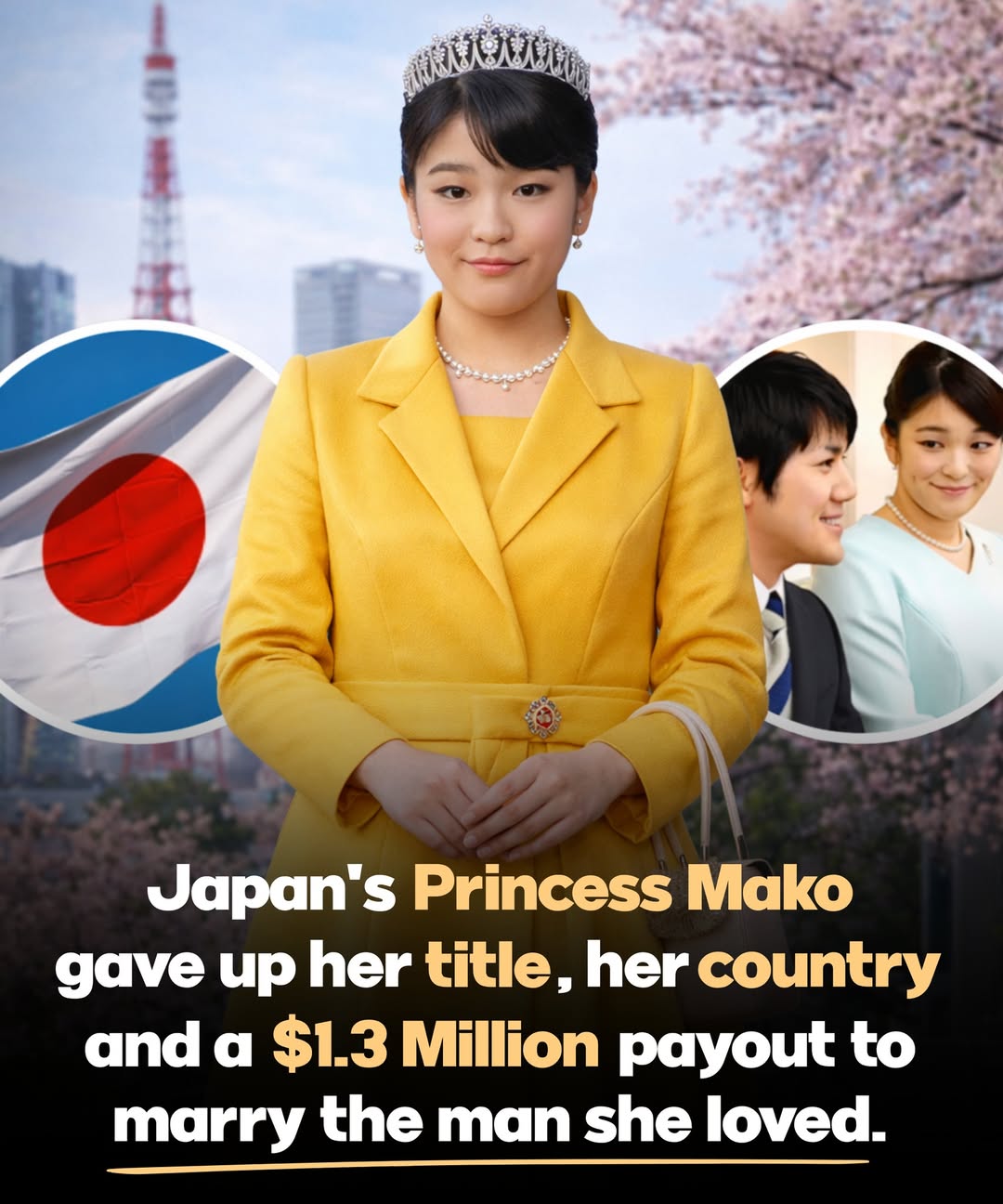
  • She was born a princess.
    But she chose love.

    Mako Komuro, niece of Naruhito, grew up surrounded by royal tradition and centuries of expectations.

    In 2012, while studying at International Christian University, she met a law student named Kei Komuro in a coffee shop.

    She later said his smile was “bright like the sun.”

    But their relationship quickly became national news. When their engagement was announced in 2017, media scrutiny and public criticism exploded. The pressure became so intense that Mako was later diagnosed with complex PTSD from the coverage.

    Still, they stayed together.

    Komuro moved to New York, studied law, and built a career while they spent years apart waiting for the storm to pass.

    On October 26, 2021, they quietly married.

    No royal ceremony.
    No celebration.

    Mako also gave up her royal title — because under Japanese law, female royals must leave the imperial family if they marry a commoner.

    She even refused the $1.3 million payment traditionally given to princesses who step away from royal life.

    Today, the couple lives in New York City, where Komuro works as a lawyer and Mako volunteers at the Metropolitan Museum of Art.

    In 2025, they welcomed their first child.

    She once explained her decision with a simple sentence:

    “Kei is irreplaceable for me.”

    A princess gave up a palace for the boy she met in a coffee shop — and chose a life built on love instead of a crown.
    She was born a princess. But she chose love. Mako Komuro, niece of Naruhito, grew up surrounded by royal tradition and centuries of expectations. In 2012, while studying at International Christian University, she met a law student named Kei Komuro in a coffee shop. She later said his smile was “bright like the sun.” But their relationship quickly became national news. When their engagement was announced in 2017, media scrutiny and public criticism exploded. The pressure became so intense that Mako was later diagnosed with complex PTSD from the coverage. Still, they stayed together. Komuro moved to New York, studied law, and built a career while they spent years apart waiting for the storm to pass. On October 26, 2021, they quietly married. No royal ceremony. No celebration. Mako also gave up her royal title — because under Japanese law, female royals must leave the imperial family if they marry a commoner. She even refused the $1.3 million payment traditionally given to princesses who step away from royal life. Today, the couple lives in New York City, where Komuro works as a lawyer and Mako volunteers at the Metropolitan Museum of Art. In 2025, they welcomed their first child. She once explained her decision with a simple sentence: “Kei is irreplaceable for me.” A princess gave up a palace for the boy she met in a coffee shop — and chose a life built on love instead of a crown.
    Like
    Love
    Wow
    3
    0 Комментарии 0 Поделились 826 Просмотры 0 предпросмотр
  • Japanese Vexillologists
    Japanese Vexillologists
    Like
    Love
    Wow
    3
    0 Комментарии 0 Поделились 129Кб Просмотры 0 предпросмотр
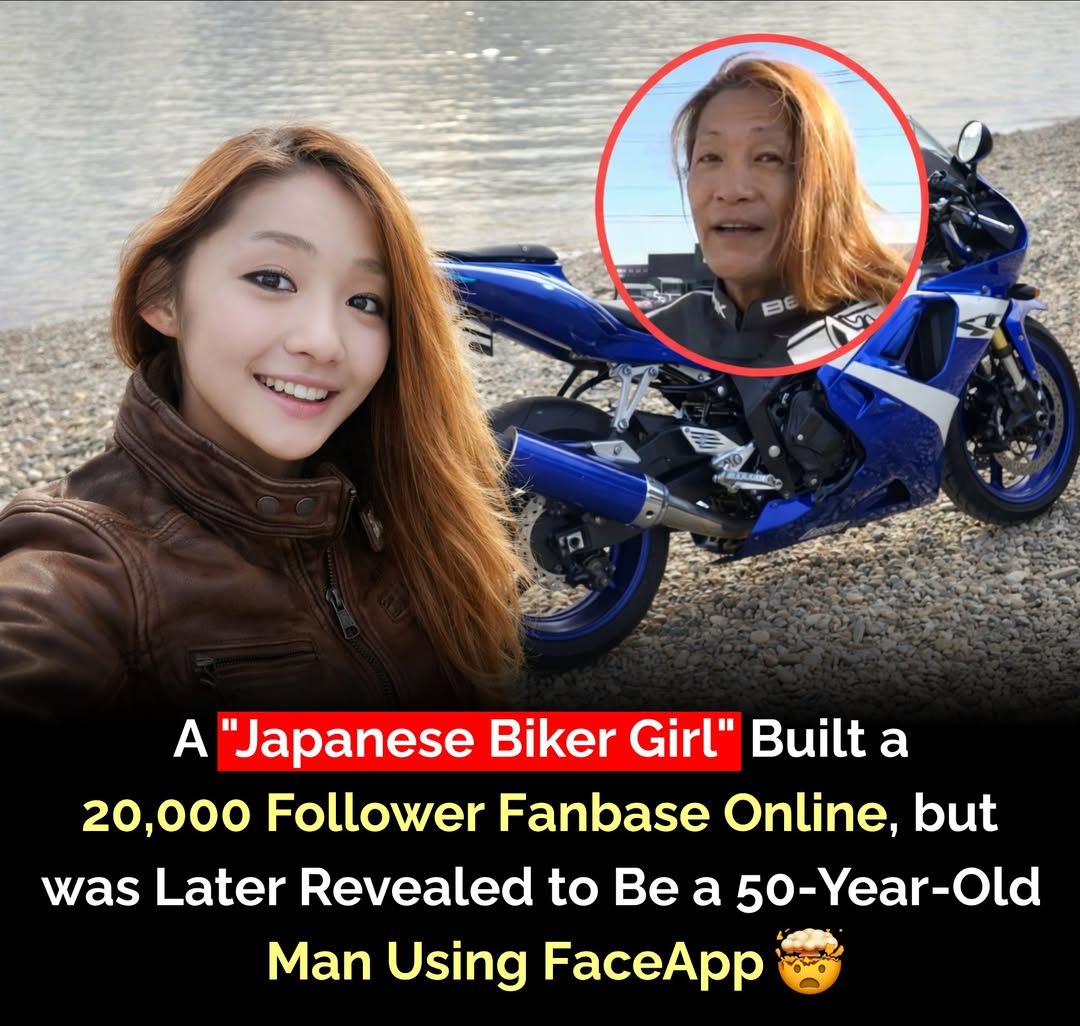
  • A Japanese social media account that appeared to belong to a young female motorcycle rider quickly grabbed attention online . The profile regularly posted cheerful selfies with bikes and travel-style photos, building a fanbase of over **20,000 followers** who loved the biker lifestyle aesthetic .

    Over time, some viewers started noticing small inconsistencies in certain pictures. Sharp-eyed followers spotted strange reflections in motorcycle photos that didn’t quite match the youthful “biker girl” identity . These tiny details sparked curiosity about who was actually behind the account.

    The mystery was eventually revealed on Japanese television . The viral “biker girl” persona turned out to be a **man in his 50s** who had been using **FaceApp and other photo-editing tools** to transform his appearance into a younger, feminine look online .

    In interviews, he explained that the goal was mainly to gain attention and engagement, admitting that a typical middle-aged man posting motorcycle photos probably wouldn’t attract the same interest on social media .

    The reveal quickly went viral and sparked discussions about how powerful modern filters and editing apps have become — and how easily a convincing online identity can be created in today’s digital world .
    A Japanese social media account that appeared to belong to a young female motorcycle rider quickly grabbed attention online . The profile regularly posted cheerful selfies with bikes and travel-style photos, building a fanbase of over **20,000 followers** who loved the biker lifestyle aesthetic . Over time, some viewers started noticing small inconsistencies in certain pictures. Sharp-eyed followers spotted strange reflections in motorcycle photos that didn’t quite match the youthful “biker girl” identity . These tiny details sparked curiosity about who was actually behind the account. The mystery was eventually revealed on Japanese television . The viral “biker girl” persona turned out to be a **man in his 50s** who had been using **FaceApp and other photo-editing tools** to transform his appearance into a younger, feminine look online . In interviews, he explained that the goal was mainly to gain attention and engagement, admitting that a typical middle-aged man posting motorcycle photos probably wouldn’t attract the same interest on social media . The reveal quickly went viral and sparked discussions about how powerful modern filters and editing apps have become — and how easily a convincing online identity can be created in today’s digital world .
    Like
    Love
    Wow
    3
    0 Комментарии 0 Поделились 2Кб Просмотры 0 предпросмотр
Расширенные страницы