


This Famous Star Is a Total Fraud, Astronomers Say
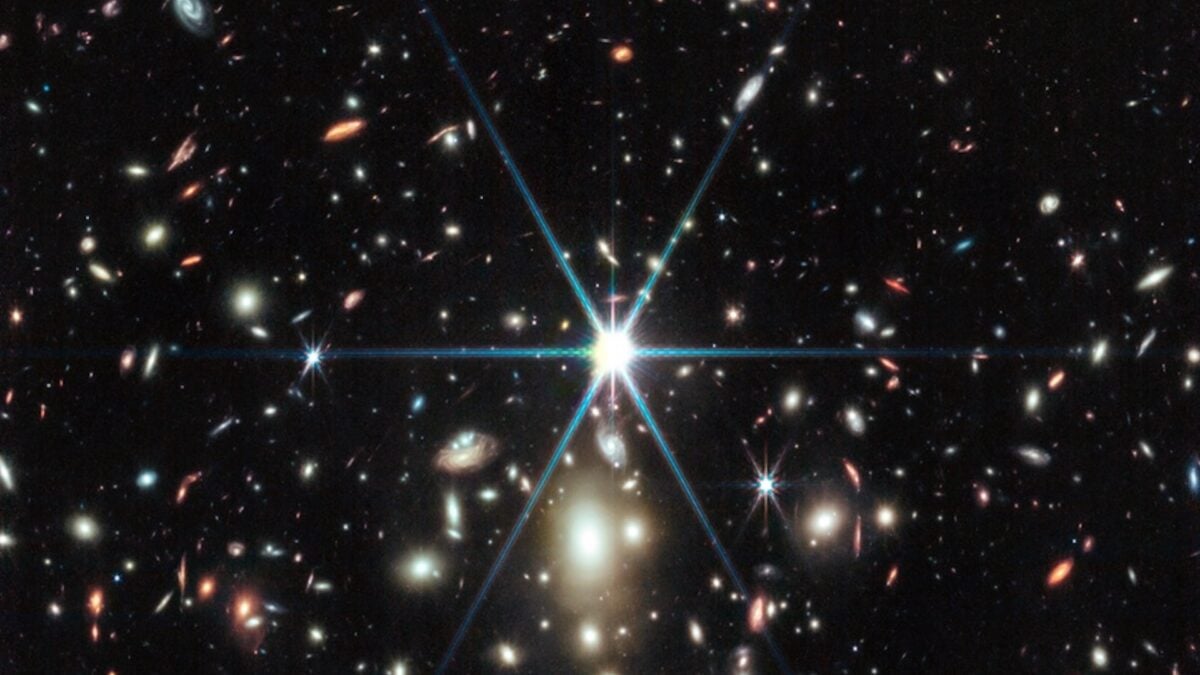
In March 2022, the Hubble Space Telescope peered through the distant cosmos and detected the light of an apparent star located 12.9 billion light-years away. Astronomers named it Earendel, meaning “morning star” in Old English, and it earned the title for the earliest and most distant star ever discovered. Now, new research suggests the record-breaking star may not be a star after all but rather a deceptive star cluster.
A team of researchers took another look at Earendel using data gathered by the Webb telescope and found that the star’s features match those of globular clusters—collections of stars packed tightly together by gravity. In a new study published in The Astrophysical Journal Letters, astronomers reexamined the size and brightness of Earendel, finding that it might have been distorted due to gravitational lensing.
Earendel is located in the Sunrise Arc galaxy and was identified as a massive B-type star more than twice as hot as the Sun and about a million times more luminous, according to NASA. Astronomers first discovered Earendel using a phenomenon called gravitational lensing, where the gravity of a massive object bends and magnifies the light coming from objects that may otherwise be too far or faint to see.
“Normally at these distances, entire galaxies look like small smudges, with the light from millions of stars blending together,” Brian Welch, an astronomer at the Johns Hopkins University in Baltimore and lead author of the paper on Earendel’s discovery, said at the time. “The galaxy hosting this star has been magnified and distorted by gravitational lensing into a long crescent that we named the Sunrise Arc.”
Gravitational lensing, however, can cause significant stretching and distortion of objects, particularly if the object has an irregular mass distribution. Based on follow-up observations of Earendel using the Webb telescope in 2023, astronomers determined that the object is magnified by a factor of at least 4,000, according to NASA. They also saw hints of a cooler, redder companion star next to Earendel.
Based on the Webb data, the astronomers behind the new study compared Earendel to another known star cluster, called 1b, in the same galaxy. The two objects had similar features, such as age and metal content, and both resemble nearby ancient star clusters. This suggests that Earendel may in fact be a collection of stars rather than one single star.
The researchers behind the study want to carry out follow-up observations of Earendel to be sure of its true identity, hoping to observe how the object flickers and whether there are fluctuations to its light source. With that, they would be able to tell whether Earendel is a record-breaking star—or just a poser.


 Language
 VN
VN
 French
 Spanish
 Portuguese
 Deutsch
 Turkish
 Dutch
Dutch
 Italiano
 Russian
 Romaian
 Portuguese (Brazil)
 Greek
Greek
 Arabic