


Flawed Tests on Earth May Explain Why NASA's Rovers Get Stuck on Mars
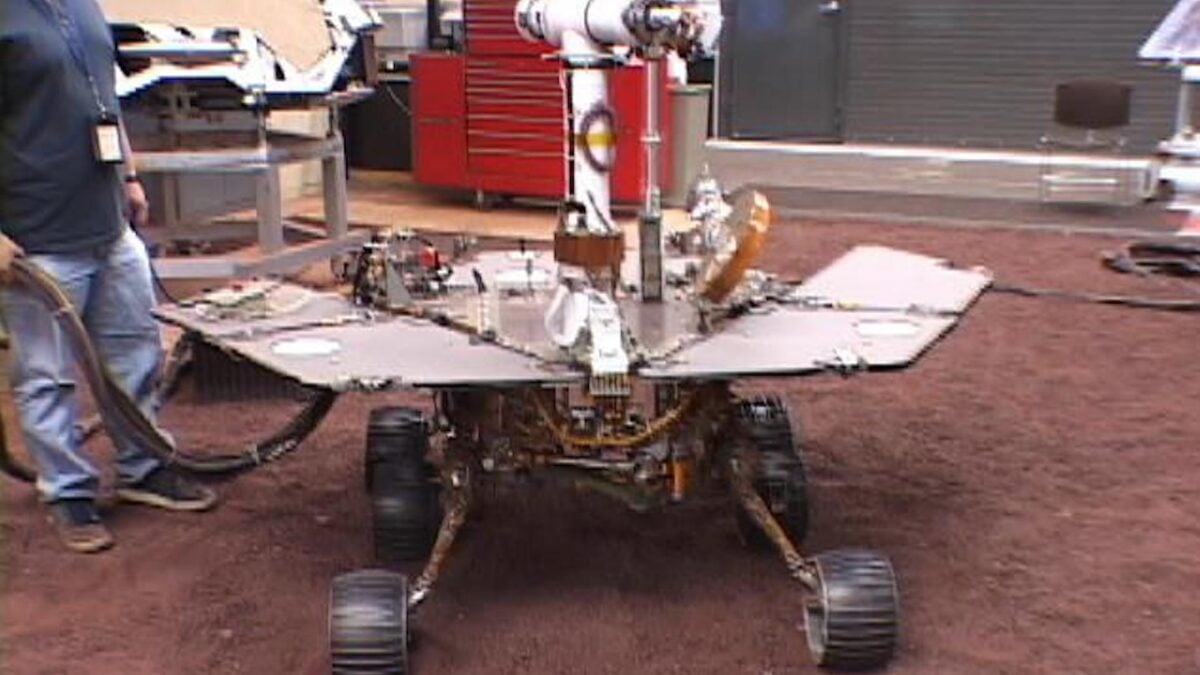
In the spring of 2019, the six-wheeled Spirit rover was driving backwards to drag an inoperable front right wheel when it got stuck on the sandy Martian surface. Despite spending months trying to excavate its robot, NASA could not free Spirit. Now, engineers from the University of Wisconsin–Madison may have figured out a way to better prepare NASA’s robots for extraterrestrial environments.
In a paper published in the Journal of Field Robotics, the team of engineers used computer simulations to uncover a missing element in the way NASA tests its rovers on Earth. Rather than only accounting for the effect of gravity on the rover prototypes being tested on Earth, the engineers behind the recent study suggest that NASA has overlooked gravity’s pull on the sand itself.
The gravity on Mars is significantly weaker than on Earth. To account for the difference in gravity between Mars and Earth, NASA engineers test a lightweight prototype of the Martian rovers that are about a sixth of the mass of the robots sent to the Red Planet. The recent simulations, however, revealed that Earth’s gravity pulls down on sand much more strongly than on Mars or the Moon. As a result, the sand on Earth is much more rigid and less likely to shift under the wheels of the rover, while it tends to be fluffier on the Moon.
“We need to consider not only the gravitational pull on the rover but also the effect of gravity on the sand to get a better picture of how the rover will perform on the Moon,” Dan Negrut, a professor of mechanical engineering at UW–Madison and lead author of the paper, said in a statement.
The team behind the study stumbled upon the missing piece of the puzzle while simulating NASA’s VIPER, or Volatiles Investigating Polar Exploration Rover, which was meant to launch to the Moon this year before its mission got canceled. While simulating VIPER’s mission, the engineers noticed discrepancies between Earth-based tests of the rover prototype and physics-based simulations of the four-wheeled robot on the Moon.
The new findings suggest that rovers on extraterrestrial terrains, like the Moon or Mars, are more likely to struggle with getting their wheels stuck in the less-cooperative sands. Something like this may have happened not just to Spirit but also to NASA’s Opportunity rover, which spent weeks stuck in sand in 2005, and Curiosity, which got bogged down in soft terrain in 2014. By considering how sand behaves under the lighter gravitational pull of other worlds, NASA can better prepare its robots for the harsh terrain ahead.


 Language
 English
 VN
VN
 French
 Spanish
 Deutsch
 Turkish
 Dutch
Dutch
 Italiano
 Russian
 Romaian
 Portuguese (Brazil)
 Greek
Greek
 Arabic