


How to Find Out If Microplastics Are Actually Destroying Our Health
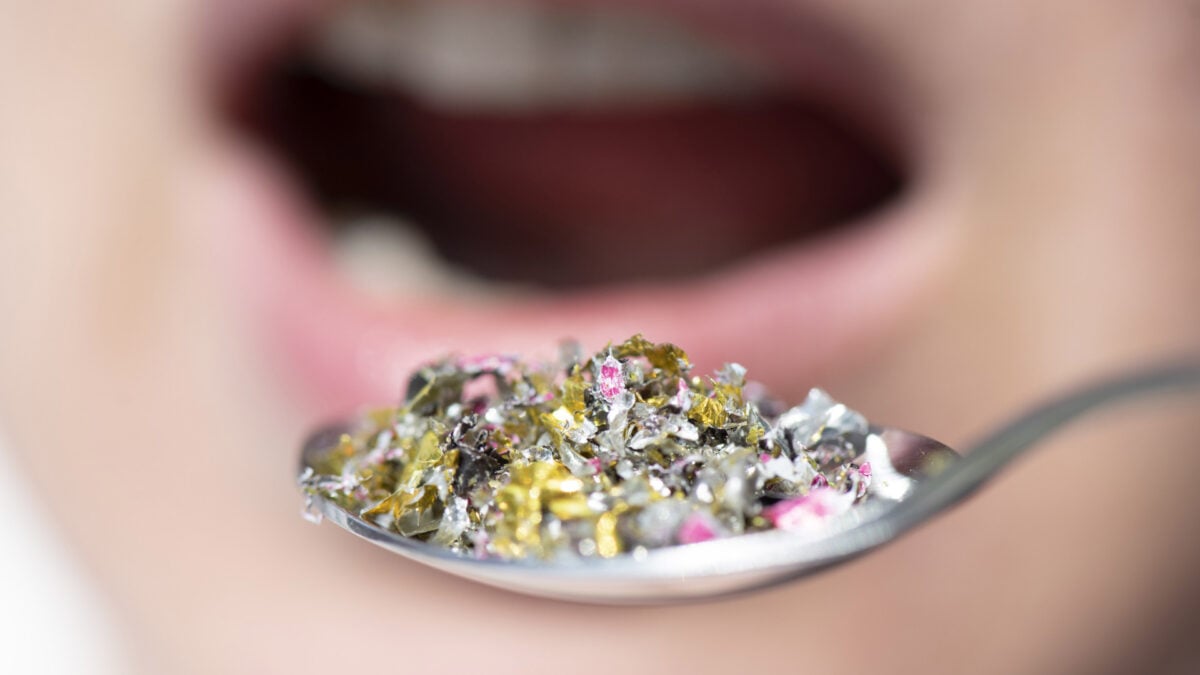
Researchers have found plastic in almost every corner of the human body, from our brains and poop to blood and testicles (at least it’s not making our stomachs crunch yet). Is this plastic contamination bad for us?
While the answer to that question might seem like a no-brainer—and certainly no one is crazy enough to theorize that microplastics in breast milk are a good thing—there haven’t been any human trials to confirm that microplastics are detrimental to human health. Some research has simply linked microplastics to health complications, which isn’t nearly definitive enough.
So what are we waiting for? To be clear, it’s not simply a matter of getting it done. To understand how or if micro- and nanoplastics (MNPs) are toxic for human health, we first need to quantify and analyze their concentration and composition in samples from living organisms. Spoiler alert—there is no guidebook on how to do this. After surveying the existing scientific literature on the matter, however, a team of researchers has outlined some best practices that could finally get us started in the right direction.
“Most detection techniques are better suited for microplastic and nanoplastic (MNP) identification in ideal media (such as water) and face limitations when analysing biological samples,” the researchers wrote in a study published last month in the journal Nature Reviews Bioengineering.
Part of the problem is that different biological samples have different compositions. Apples, for example, are fibrous, while our bodies also have fats and proteins, and trees and plants have lignin, Baoshan Xing, an environmental and soil chemistry professor at UMass Amherst and lead author of the study, said in a university statement.
“Strategies for digestion [preparation], separation, enrichment and detection of MNPs need to be optimized depending on the category of organism under investigation,” the researchers explained in the study. Currently, there is no standard approach for this, an unfortunate fact that Xing described as a “headache” in the statement.
Another complication is that most studies in this context presume MNPs to be spherical-shaped. That might not be the case, which carries important implications, given that particle shape can impact how MNPs travel through a system. Plus, toxic substances might collect in tiny niches or cavities. As such, the team argues that researchers need protocols for analyzing the polymer types and shapes, as well as MNPs’ surface characteristics.
If that sounds like a whole lot of features to analyze, you’re not wrong. Luckily, “machine learning algorithms can greatly reduce the labour time and cost of MNP identification and characterization,” the researchers pointed out in the study.
“The day is not far off when we’ll be able to accurately detect, characterize and quantify MNPs in biological samples,” Xing concluded in the statement.
In the meantime, though, stop chewing gum. Just in case.


 Language
 VN
VN
 French
 Spanish
 Portuguese
 Deutsch
 Turkish
 Dutch
Dutch
 Italiano
 Russian
 Romaian
 Portuguese (Brazil)
 Greek
Greek
 Arabic