


New Brain Interface Interprets Inner Monologues With Startling Accuracy
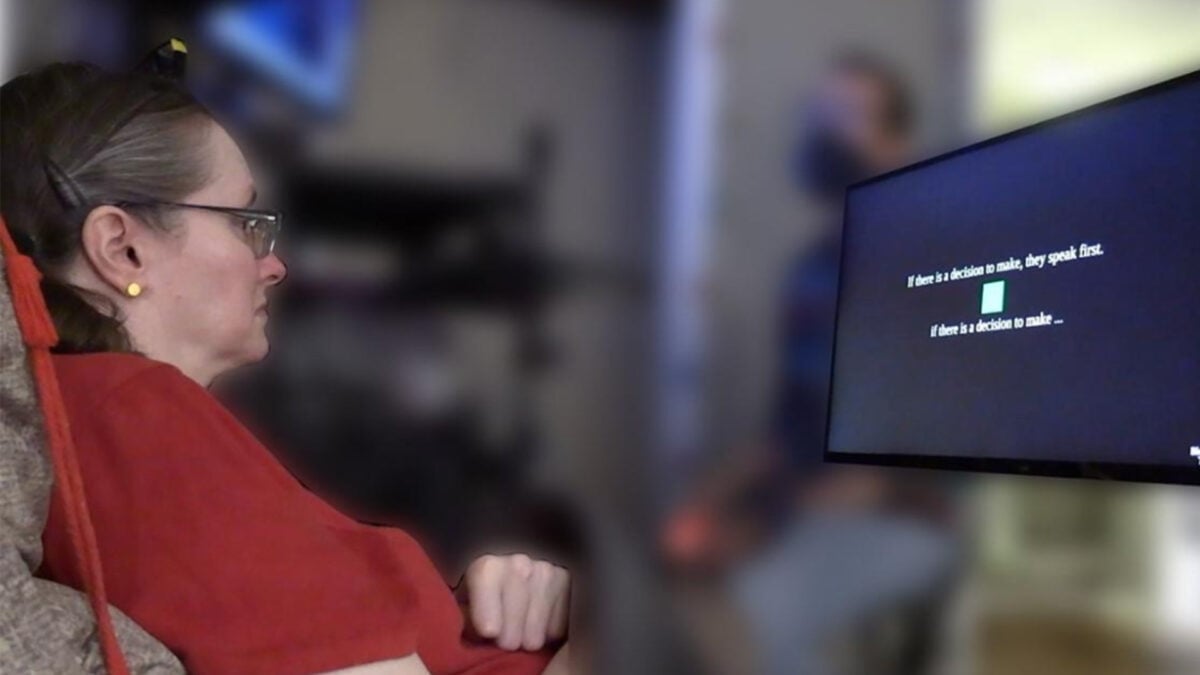
Scientists can now decipher brain activity related to the silent inner monologue in people’s heads with up to 74% accuracy, according to a new study.
In new research published today in Cell, scientists from Stanford University decoded imagined words from four participants with severe paralysis due to ALS or brainstem stroke. Aside from being absolutely wild, the findings could help people who are unable to speak communicate more easily using brain-computer interfaces (BCIs), the researchers say.
“This is the first time we’ve managed to understand what brain activity looks like when you just think about speaking,” lead author Erin Kunz, a graduate student in electrical engineering at Stanford University, said in a statement. “For people with severe speech and motor impairments, BCIs capable of decoding inner speech could help them communicate much more easily and more naturally.”
Previously, scientists have managed to decode attempted speech using BCIs. When people physically attempt to speak out loud by engaging the muscles related to speech, these technologies can interpret the resulting brain activity and type out what they’re trying to say. But while effective, the current methods of BCI-assisted communication can still be exhausting for people with limited muscle control. The new study is the first to directly take on inner speech.
To do so, the researchers recorded activity in the motor cortex—the region responsible for controlling voluntary movements, including speech—using microelectrodes implanted in the motor cortex of the four participants.
The researchers found that attempted and imagined speech activate similar, though not identical, patterns of brain activity. They trained an AI model to interpret these imagined speech signals, decoding sentences from a vocabulary of up to 125,000 words with as much as 74% accuracy. In some cases, the system even picked up unprompted inner thoughts, like numbers participants silently counted during a task.
For people who want to use the new technology but don’t always want their inner thoughts on full blast, the team added a password-controlled mechanism that prevented the BCI from decoding inner speech unless the participants thought of a password (“chitty chitty bang bang” in this case). The system recognized the password with more than 98% accuracy.
While 74% accuracy is high, the current technology still makes a substantial amount of errors. But the researchers are hopeful that soon, more sensitive recording devices and better algorithms could boost their performance even more.
“The future of BCIs is bright,” Frank Willett, assistant professor in the department of neurosurgery at Stanford and the study’s lead author, said in a statement. “This work gives real hope that speech BCIs can one day restore communication that is as fluent, natural, and comfortable as conversational speech.”


 Language
 English
 VN
VN
 Spanish
 Portuguese
 Deutsch
 Turkish
 Dutch
Dutch
 Italiano
 Russian
 Romaian
 Portuguese (Brazil)
 Greek
Greek
 Arabic