


This Newly Launched Satellite Just 'Bloomed' a Record-Breaking Antenna in Orbit
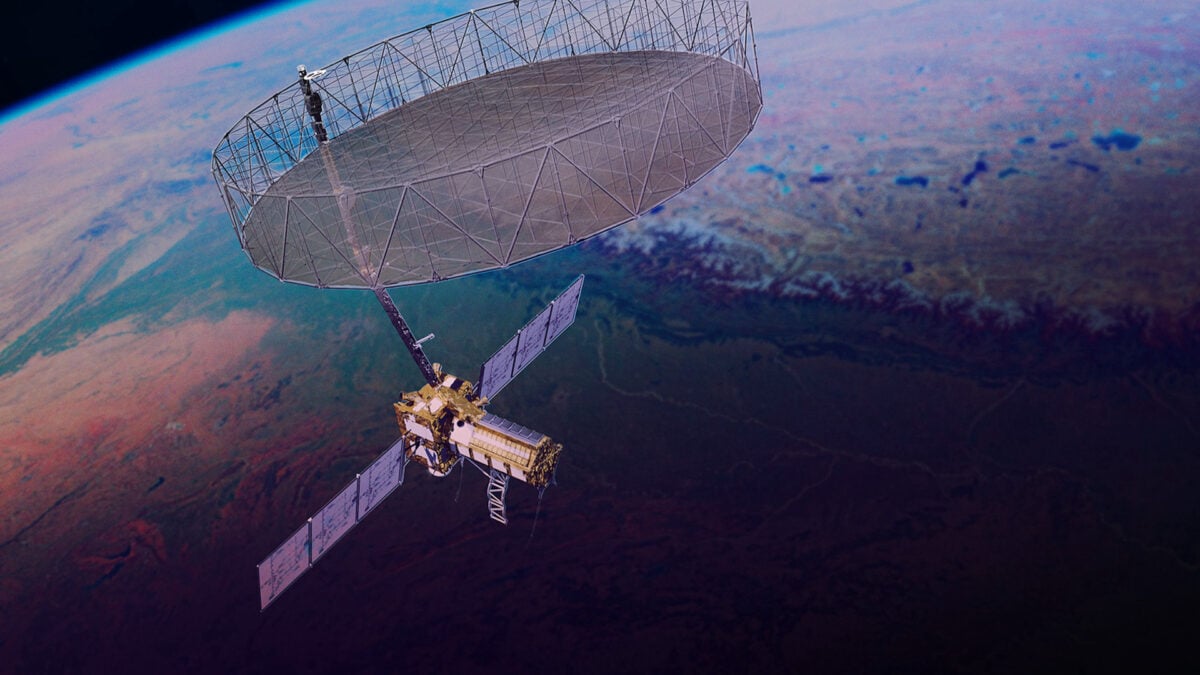
A first-of-its-kind satellite recently launched into orbit to monitor Earth’s changing surfaces, detecting movement of the planet’s crust down to fractions of an inch. The satellite packed a giant radar antenna, folded like an umbrella, and it just unfurled the massive, drum-shaped structure through an intricate process that brought it to full bloom.
The NISAR mission, a joint effort between NASA and the Indian space agency ISRO, launched on July 30 from Satish Dhawan Space Centre in India. More than two weeks later, the satellite deployed its antenna reflector, which spans 39 feet (12 meters) wide—the largest ever used on a NASA mission. The team behind the mission began the process on August 9, unfolding the satellite’s boom one joint at a time and then firing a series of explosive bolts so that it could be deployed and locked into place in space.
“We were of course eager to see the deployment go well. It’s a critical part of the NISAR Earth science mission and has taken years to design, develop, and test to be ready for this big day,” Phil Barela, NISAR project manager at NASA’s Jet Propulsion Laboratory in Southern California, said in a statement. “Now that we’ve launched, we are focusing on fine-tuning it to begin delivering transformative science by late fall of this year.”
NISAR, short for NASA-ISRO Synthetic Aperture Radar, is designed to produce a three-dimensional view of Earth in unprecedented detail. The mission is equipped with the most sophisticated radar system for a NASA mission. The antenna reflector plays a key role for NISAR’s two synthetic aperture radar (SAR) systems, which use the motion of the radar antenna over its targeted area to create high-resolution images.
“Synthetic aperture radar, in principle, works like the lens of a camera, which focuses light to make a sharp image,” Paul Rosen, NISAR’s project scientist at JPL, said in a statement. “The size of the lens, called the aperture, determines the sharpness of the image.” The first radar system, L-band, can see through clouds and forest canopy. The second, an S-band system provided by ISRO, can see through clouds as well but is more sensitive to light vegetation and moisture in snow, according to NASA.
The reflector weighs about 142 pounds (64 kilograms) and comes with a cylindrical frame made of 123 composite struts and a gold-plated wire mesh. At the beginning of the process, NISAR’s boom began unfolding one joint at a time after being tucked in close to the satellite’s body. It took four days for it to become fully extended. On August 15, the team fired a series of small explosive bolts that held the reflector assembly in place to begin what NASA calls the “bloom” process. Through this process, the antenna unfurled by releasing tension stored in its flexible frame while it was tucked away like an umbrella. The team then activated motors and cables that pulled the antenna to its final form, blooming in its full glory.
The reflector is as wide as the length of a school bus, enabling NISAR to image Earth’s surface down to pixels about 30 feet (10 meters) across. “Using special interferometric techniques that compare images over time, NISAR enables researchers and data users to create 3D movies of changes happening on Earth’s surface,” Rosen said.


 Language
 English
 VN
VN
 French
 Spanish
 Portuguese
 Turkish
 Dutch
Dutch
 Italiano
 Russian
 Romaian
 Portuguese (Brazil)
 Greek
Greek
 Arabic