


Howard Lutnick Calls CHIPS Act a 'Giveaway to Rich Companies' Like Intel
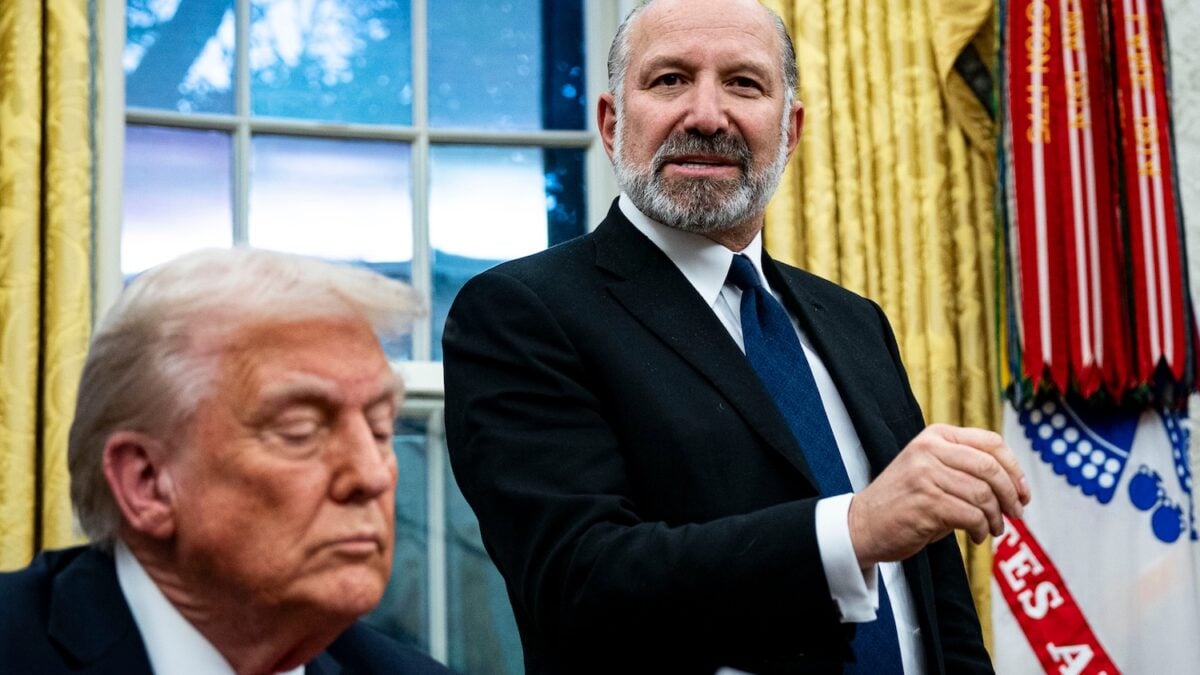
The U.S. government could get a 10% equity stake in Intel in exchange for more funds from the CHIPS Act, according to Commerce Secretary Howard Lutnick, who appeared on CNBC Tuesday. Lutnick was pressed about whether that would be a worse deal than what Intel had previously received under the Biden-era manufacturing plan, and the commerce secretary seemed more than happy to acknowledge it was.
“Of course it’s worse, of course it’s worse…” Lutnick said, laughing. CNBC host David Faber asked if that made it difficult for U.S.-based tech giant Intel to actually compete against companies like Taiwan-based TSMC—a concern because chip manufacturers overseas are eating Intel’s lunch. But Lutnick didn’t buy the argument.
“The CHIPS Act was just a giveaway to rich companies,” Lutnick said. “I mean, why in the world is the United States of America taking money and giving it to companies like TSMC, which is worth a trillion dollars? I mean, why would we give them money to come to America?”
The CHIPS Act passed with bipartisan support in 2022 and allocated $39 billion for subsidies in an effort to spur chip manufacturing in the U.S. and better compete with China. TSMC received $6.6 billion in grants to expand chip production in the U.S. under the law, while Intel has received about $7.9 billion, according to CNBC. Intel has struggled in recent years, announcing plans last month to lay off about 15% of its staff and dramatically slowing its expansion, which means much of the money it has available hasn’t been handed over yet under the terms of the legislation.
Lutnick insisted that Trump has secured better deals with technology companies, while Biden has been just handing out money without getting more for the U.S. government. The commerce secretary said he wanted Intel to succeed, but it was going to come with strings.
“The Biden administration literally was giving Intel for free and giving TSMC money for free,” Lutnick said. “And all these companies just giving them money for free. And Donald Trump turns that into saying, ‘Hey, we want equity for the money. If we’re going to give you the money, we want a piece of the action for the American taxpayer.'”
The New York Times notes that turning $10.86 billion in grants for Intel into equity (about 10% of Intel’s $100 billion worth), would be one of the largest U.S. government interventions into private industry since the 2008 financial crisis, when the government poured billions into Chrysler and General Motors to save auto manufacturing jobs.
Lutnick was asked if the government would get any governance role in Intel with a 10% stake, and he said they would not. In fact, he treated it as a ridiculous question, insisting “we’re just converting what was a grant under Biden into equity.” But it’s not a ridiculous question, and Faber pointed out the government received a “golden share” on the U.S. Steel deal, which allows Trump to veto corporate decisions he doesn’t like. That kind of intervention obviously makes Wall Street a little nervous.
CNBC host Carl Quintanilla read excerpts from a recent Wall Street Journal editorial titled “The Nationalization of Intel,” which referred to the Trump regime’s plans as “corporate statism.” From the article:
Details of that potential investment are vague, but you can bet the feds wouldn’t be passive investors. Intel’s stock rallied last week on the news, perhaps because investors figure the company will now be too big to fail.
They’re probably right. Once the government acquires a stake in Intel, the politicians will have an incentive to keep pouring on subsidies so they wouldn’t have to admit a mistake. At the same time, the Administration’s conditions for the equity investment may also make it harder for Intel to undertake needed changes to become more competitive. Politicians don’t like to preside over plant closures or employee layoffs. See Renault, the French car maker, for that political lesson.
Lutnick just laughed it off, indignantly pointing out that “we were just giving away the money” under the previous terms of the CHIPS Act. But the legality of any equity stake would likely be challenged by both Intel shareholders and competitors in the industry, according to the Times.
President Trump has leaned heavily on Intel, firing off a post on Truth Social about CEO Lip-Bu Tan and his alleged links to China. The president even called for Tan’s resignation, saying there was “no other solution to this problem,” but seemed to back off that demand last week after meeting with the CEO.
Lutnick insisted on CNBC that Trump’s approach was necessary and much better than anything Biden had accomplished, a common refrain among Trump’s supporters.
“How could that not be smarter, better, and more important for the American taxpayer than just free money for $100 billion, trillion-dollar companies… makes no sense. Donald Trump is fixing what Biden got completely, totally, and utterly wrong,” Lutnick said.


 Language
 English
 VN
VN
 French
 Spanish
 Portuguese
 Deutsch
 Turkish
 Italiano
 Russian
 Romaian
 Portuguese (Brazil)
 Greek
Greek
 Arabic