


White Noise Makes Beer Brew Faster, Scientists Claim
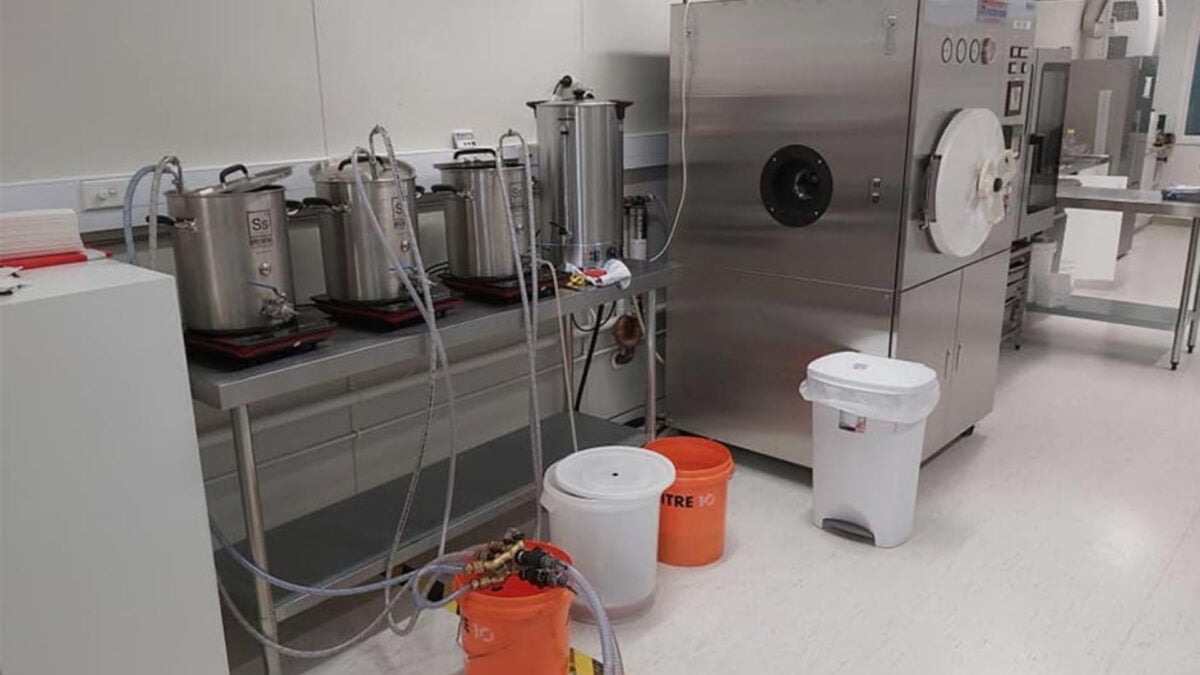
Music can make people do things faster, with running, dancing, and doing chores being good examples. It seems, however, that we’re not alone in picking up the pace at the sound of a good tune.
Researchers have discovered that playing a sound commonly known as white noise can shorten fermentation—arguably the most important step in brewing beer—by 21 to 31 hours, without markedly changing the flavor. This could help breweries increase beer production without diminishing quality.
How sound changes beer fermentation
Sound consists of two parts: pressure changes (with areas of compression and rarefaction) and particle motion, where particles in the medium vibrate and pass that movement to nearby particles. “This study investigates the effect that the particle motion component of audible sound has on beer fermentations using linear actuators (LAT) that predominantly deliver the particle motion component of sound rather than the pressure component,” the researchers wrote in a paper published in May in the journal Food Research International. In other words, the scientists wanted to find out if vibrations, rather than loud sound pressure, might speed up the fermentation process.
[embed]https://www.youtube.com/watch?v=KGFOP0RkOw0[/embed]
Fermentation is when yeast—strains of single-celled fungi species—converts sugars into alcohol and carbon dioxide. The process can take days to weeks, but when the researchers used specialized devices, the LATs, to transmit the white noise into the beer, the fermentation happened faster.
“The application of sound stimulation increased the yeast growth by maintaining a higher concentration of yeast cells in suspension,” Parise Adadi, lead author of the study and a researcher in food sciences at the University of Otago – Ōtākou Whakaihu Waka, said in a university statement. “The sound energy stimulated cellular processes and metabolic pathways, enhancing yeast growth and activity. This led to faster consumption of wort sugars and subsequent production of alcohol; but importantly did not significantly alter the flavour composition of the final beer.”
Adadi and his colleagues concluded this after comparing two batches of beer: one that experienced the sound simulation and one that did not. The beer that was treated with sound fermented faster. For the experiments, the scientists used white noise between 800 and 2,000 hertz, delivered at intensities close to 140 decibels.
Benefits of faster fermentation
Faster fermentation boosts production efficiency, allowing brewmasters to make more beer without sacrificing quality. And since it has little effect on volatile compounds, the flavor and aroma stay consistent, Adadi explained. “Furthermore, if audible sound stimulation proves scalable, it could revolutionise fermentation technology, sparking innovations across other fermented products such as wine and spirits,” he added.
Adadi and his team’s work could also have implications outside of the alcohol industry. Think how fast you could make yogurt, kombucha, sauerkraut, and kimchi!


 Language
 English
 VN
VN
 French
 Portuguese
 Deutsch
 Turkish
 Dutch
Dutch
 Italiano
 Russian
 Romaian
 Portuguese (Brazil)
 Greek
Greek
 Arabic