


Rare Supernova Rips Open a Star, Revealing Its Hidden Anatomy
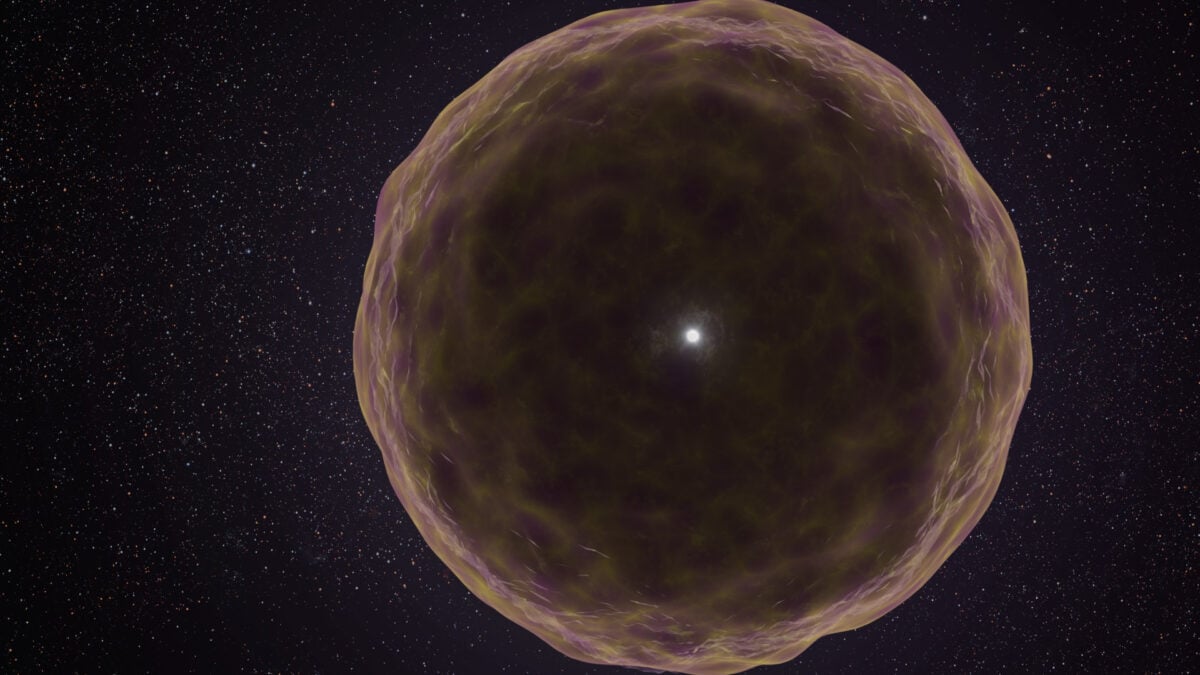
A new discovery offers fresh insights into the life cycle of massive stars and their imminent death.
On September 6, 2021, Steve Schulze, a researcher at Northwestern University, was on the lookout for fresh supernovas when he came across a strange explosion that left behind an extremely exposed corpse. The dying star had a rather stressful death, stripping down to its stellar bone and exposing its inner layers. “We quickly noticed that this supernova was unlike anything we had seen before,” Schulze told Gizmodo.
As massive stars approach their death, they develop a structure of shells made up of different elements. Those shells are hard to observe, however, since the star’s explosive death mixes the layers together. For the first time, astronomers have been able to see the distinct layers that make up a star through a recently discovered supernova, dubbed 2021yfj—and it is unlike anything they expected. The discovery, detailed in a new paper in the journal Nature, challenges existing models of stellar life cycles and the processes that lead to their explosive deaths.
When stars are born, they’re shiny balls of hydrogen. Due to the pressure and temperature at a star’s core, the hydrogen fuses into helium, which then turns to carbon and so on until it produces iron at its core. “This transforms the star into a layered structure,” Schulze said. A layer rich in oxygen, silicon, and sulfur is buried under many other materials and forms just months before the star explodes, making it impossible to observe directly—until now.
The Zwicky Transient Facility in San Diego, California, first spotted supernova 2021yfj while monitoring the night skies every two to three days. Following initial observations, the researchers behind the discovery got to work in identifying the mysterious features of its spectrum and found that they were produced by silicon, sulfur, and argon. They also detected traces of helium in the supernova’s spectrum. “Any helium should have been consumed during earlier fusion stages,” Schulze said. “So, detecting helium in the spectrum of SN 2021yfj is very puzzling.”
The observations of a star stripped down to its oxygen- and silicon-rich layers are indicative of an extremely rare stripping process, which can occur due to strong stellar winds, eruptions, or interactions with a companion star, according to the researchers.
“This is the first time we observed the inner shells of a massive star, which is significant for testing and enhancing our models of stellar evolution,” Schulze said. “Observations of stripped stars and supernovae are vital for improving and validating stellar evolution models.”
“SN 2021yfj reveals that our understanding of how massive stars evolve and end their lives is still incomplete,” he added.


 Language
 VN
VN
 French
 Spanish
 Portuguese
 Deutsch
 Turkish
 Dutch
Dutch
 Italiano
 Russian
 Romaian
 Portuguese (Brazil)
 Greek
Greek
 Arabic