


Stone Age People Brutalized Their Prisoners of War, New Evidence Suggests
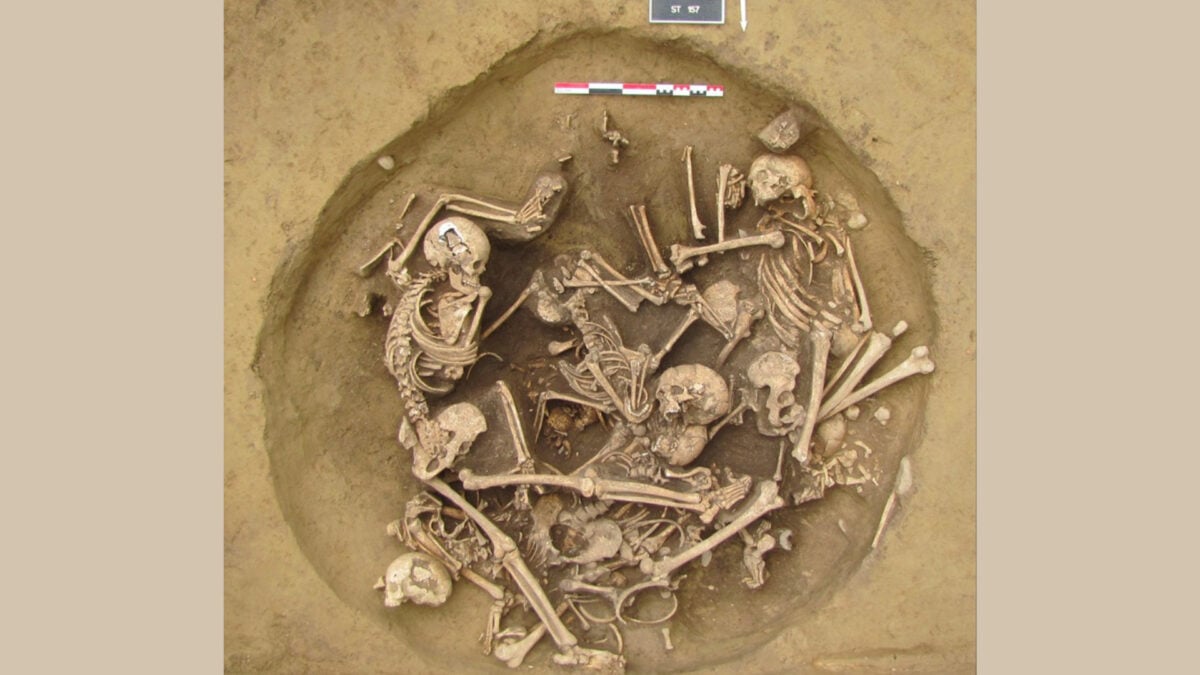
When we think of Stone Age people, most imagine small communities living in caves, cutting into their most recent hunt with primitive tools, and imitating their environment with illustrative rock art. People during the Neolithic, however—the last stage of the Stone Age (around 9000 to 3300 BCE)—also waged wars and absolutely demolished their enemies.
In a study published today in the journal Science Advances, researchers present horrific evidence suggesting that Neolithic people in northeastern France mutilated foreign invaders. Their findings might represent some of the earliest known indications of gruesome victory celebrations related to war.
The international team of researchers analyzed skeletal remains and severed limbs from burial pits dating to between 4300 and 4150 BCE at two sites near Strasbourg, Achenheim and Bergheim. “A total of 82 humans are analyzed,” they wrote in the study.
Some remains bore gruesome wounds
Their analysis revealed “differences between victims and nonvictims and suggest that the former were members of invading groups brutally killed, perhaps exposed and deposited in pits—together with trophies in the form of severed upper limbs—by local groups in what might be one of the earliest well-documented instances of martial victory celebrations in prehistoric Europe,” they explained.

Previous research in the Upper Rhine Valley had already shown that this time period was marked by military invasions and cultural upheaval, but scientists didn’t know whether the human remains at Achenheim and Bergheim were of locals or foreigners and/or prisoners of war.
In addition to the severed upper limbs, the researchers also identified injuries such as skull fractures that had not healed. The team, including Valladolid University’s Teresa Fernandez-Crespo, suggests these victims met violent ends during war. The individuals without these sorts of unhealed injuries, on the other hand, likely received a regular burial.
Victims were likely invaders
To investigate the differences between those who were brutally killed and those who weren’t, Fernandez-Crespo and her colleagues conducted isotopic analyses. By identifying ratios of isotopes—variants of the same element—in the remains, they discovered that, while the non-victims were locals, the victims of war violence came from other regions. According to the researchers, this indicates that the victims were likely invaders killed by locals.
“In view of their demise, it is probable that the identities of these victims can be attributed to socially remote, nonlocal enemies that became trophies or captives during battles or raids and that may have been considered by their captors as not properly ‘human’ and hence warranting such treatment,” the researchers explained.
For once, the term “overkill” applies literally.


 Language
 English
 VN
VN
 French
 Spanish
 Deutsch
 Turkish
 Dutch
Dutch
 Italiano
 Russian
 Romaian
 Portuguese (Brazil)
 Greek
Greek
 Arabic