


Man Experiences Joy For the First Time in Decades After Brain Stimulation Treatment
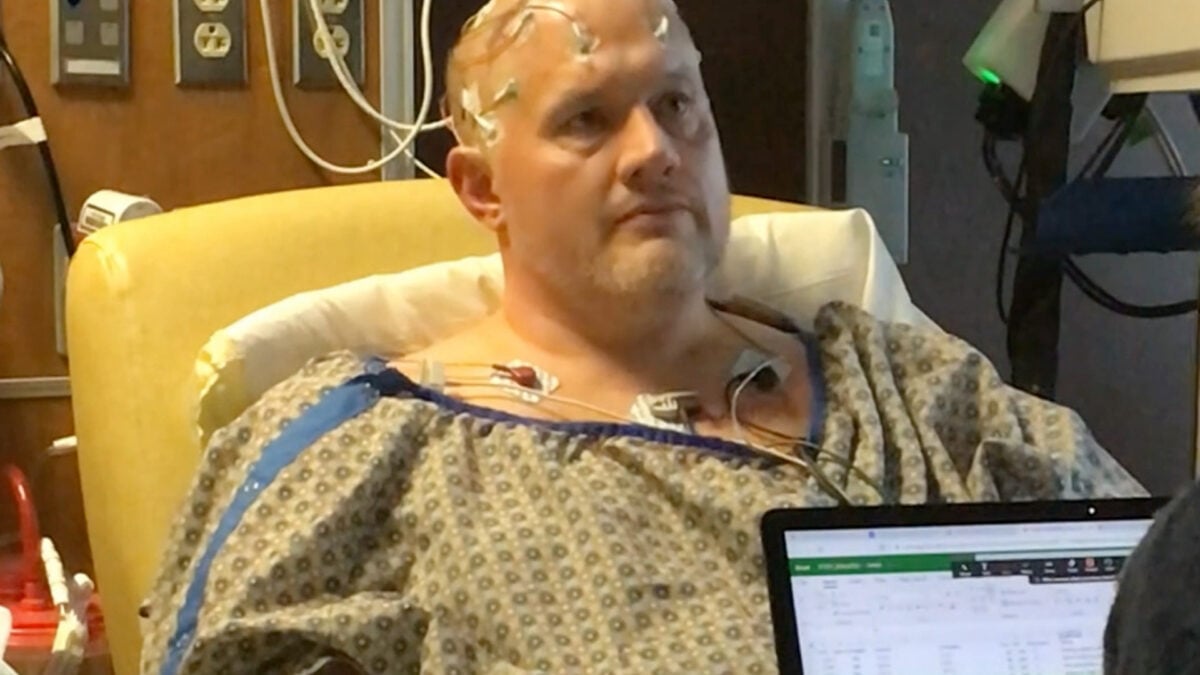
A man who lived with severe, treatment-resistant depression for over 30 years is now in remission, thanks to a new brain stimulation method that targets selective areas of his brain.
The man reported experiencing joy for the first time in decades after the treatment. “He was crying and saying, ‘I’m not sad, I’m just happy. I don’t know what to do with these emotions’,” the study’s first author, Ziad Nahas, a psychiatrist and professor at the University of Minnesota, told Gizmodo.
Nahas and a team of researchers across several universities developed a personalized method to implant electrodes and precisely send weak electrical signals into brain areas believed to be involved in depression. By fine-tuning this stimulation using the patient’s feedback, the treatment has relieved the participant’s symptoms for up to two years. Their findings are detailed in a new preprint on PsyArXiv, which has not yet been peer-reviewed.
When depression resists treatment
The study’s single participant initially contacted the researchers while they were recruiting for a new clinical trial. At the time, he had been living with treatment-resistant depression for three decades, having first been hospitalized at age 13. Since then, he had undergone multiple hospitalizations and tried dozens of treatments alongside intensive psychotherapy. He had also attempted suicide three times.
Treatment-resistant depression is a common form of major depressive disorder that does not improve significantly after at least two standard treatment attempts, such as medications or therapy. In such cases, electroconvulsive therapy (ECT)—which stimulates the brain using weak electrical currents—is often considered a next step. While ECT has been used for decades and can be effective for some patients, it fails for others.
In this patient’s case, brain stimulation had previously failed to alleviate any symptoms. He had undergone two courses of electroconvulsive stimulation therapy. The first was moderately effective, but the second and third brought no relief.
The problem is that most ECT studies stimulate specific brain areas based on a standard brain atlas, Damien Fair, a neuroscientist and professor at the University of Minnesota and a study co-author, explained to Gizmodo. That means that researchers don’t often know exactly which area they’re targeting, since everyone’s brain is different. “It’s a one-size-fits-all approach,” said Fair.
A tailored approach
To address this, the team developed a personalized stimulation method tailored to the participant’s brain. First, they used functional MRI (fMRI) to map the borders of his brain networks previously linked to depression. This revealed that the patient’s salience network, which processes external stimuli, was about four times larger than in people without depression, potentially contributing to his symptoms, Fair said.
Next, the researchers surgically implanted four clusters of electrodes into the brain, over the borders of these brain networks. A few days later, they began sending electrical signals into each of the four networks individually.
When they stimulated the default mode network (DMN), a group of regions linked to internal thought processes, the patient began to experience happiness. Nahas immediately called Fair. “[Nahas] said, ‘You won’t believe it. We stimulated the default network, and [the participant] is breaking down in tears of joy,’” Fair recalled.
Stimulating the action-mode network, which is involved in planning, and the salience network both led the man to report a sense of calm. Targeting the frontoparietal network, which is involved in decision-making, resulted in improved focus.
Over the next six months, the patient received electrical stimulation in the various brain networks each day for 1 minute, every 5 minutes. The researchers continued to adjust the stimulation settings each month using a statistical method that incorporated the patient’s daily feedback.
By seven weeks post-surgery, the participant no longer experienced suicidal thoughts. By six months, his symptoms had significantly improved. By nine months, he had entered full remission. That remission has lasted for two years.
“The uniqueness of PACE is combining very precise, individualized targeting of multiple networks and tuning the parameters so the patient can receive the most benefit,” Nahas said.
The team has since implanted a second participant and plans to implant a third. Ultimately, they aim to conduct a double-blind clinical trial.
Nahas recently received an email from the original participant, who had embarked on a road trip with his family. He was enjoying his trip, he said. “In psychiatry, we don’t have cures,” Nahas said, “but this is probably the closest we can get.”


 Language
 English
 VN
VN
 French
 Spanish
 Portuguese
 Deutsch
 Turkish
 Dutch
Dutch
 Italiano
 Russian
 Romaian
 Portuguese (Brazil)
 Arabic