


Origami Space Planes Could Solve a Major Problem in Orbit
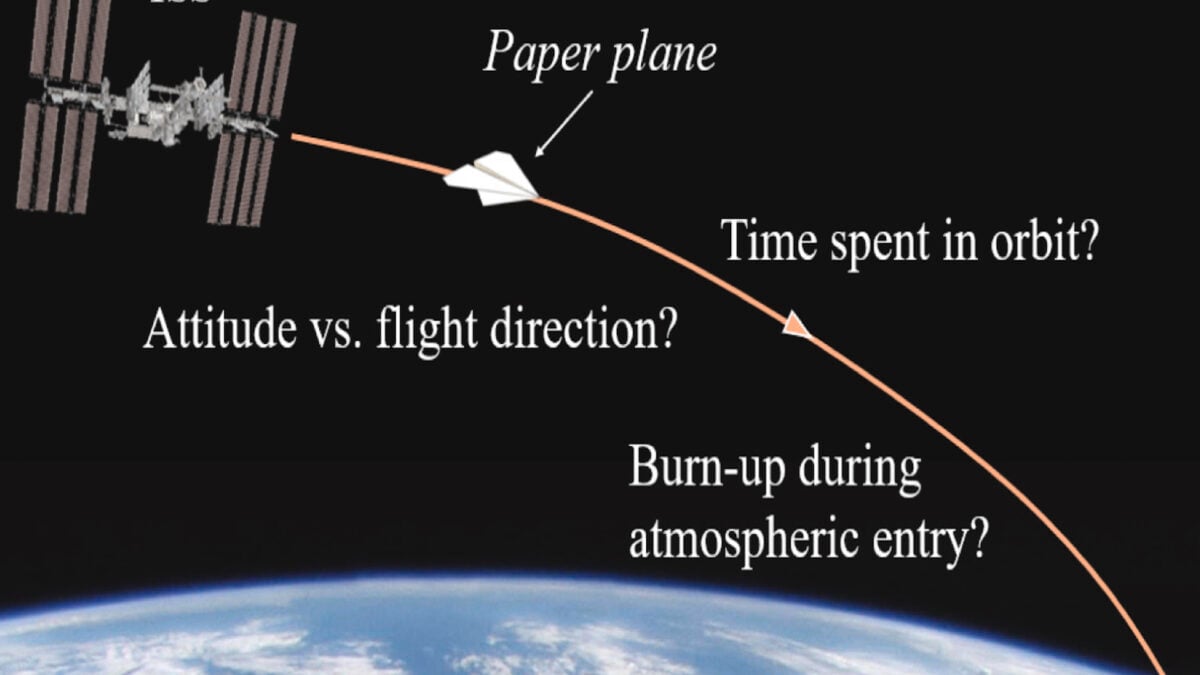
Building a spacecraft could one day be as simple as folding a piece of paper into a plane and letting aerodynamics do the rest. A team of researchers from the University of Tokyo simulated the release of a paper airplane from the International Space Station (ISS) to see if would survive atmospheric reentry.
In a paper published in Acta Astronautica, the researchers demonstrated how origami may be the solution to low Earth orbit’s growing trash problem. Rather than relying solely on metals to construct spacecraft, the team behind the paper argues that a standard sheet of paper could do the job instead and easily burn up in the atmosphere during reentry. For their study, the researchers created a paper plane with an aluminum tail and placed it in a wind tunnel to see how it would fare in space. The idea is simple, and it aims to show how organic materials can be used to create a more sustainable orbital environment.
The origami space plane is made from a sheet of uncoated A4 printing paper, with folded layers at the nose to shift its center of mass upstream and ensure aerodynamic stability. “Such spacecraft have not yet flown in space,” the paper reads. “It is unclear whether their flight dynamics in the highly rarefied atmosphere in [low Earth orbit] would be similar to those of a usual ground-based origami plane, and whether the plane would survive or burn up during atmospheric entry.” Of course, the entire spacecraft wouldn’t be made solely of paper. Instead, specific components—like a wing or drag sail—could be constructed from paper-based materials.
To test it out, the researchers first created a simulation of the paper plane being launched from the ISS at an altitude of 248 miles (400 kilometers) and a speed of 17,448 miles per hour (7,800 meters per second). The paper plane remained stable and glided through the space-like conditions. It began to tumble at a lower altitude of 74 miles above Earth’s surface (120 kilometers) and spun out of control. The tumbling motion is expected at this altitude, and the severe aerodynamic heating would result in the paper plane burning up in the atmosphere at around 55 to 58 miles (90 to 110 kilometers) altitude, according to the paper.
The researchers then placed a physical model in the Kashiwa Hypersonic and High Enthalpy Wind Tunnel at the University of Tokyo to see how it would hold up during reentry conditions. They subjected it to Mach 7 speeds for about seven seconds, during which the plane’s nose bent and the wings showed signs of charring. It didn’t fully disintegrate, though, but it most likely would have had they kept it in there for a longer period of time, the researchers said.
Upon atmospheric reentry, traditional spacecraft leave behind metallic particles and chemicals that damage the ozone layer. The paper plane, on the other hand, is made of organic material that doesn’t pose an environmental threat. Still, there are some challenges that remain. Considering how small the paper plane is, it does not reflect radar strongly enough and would be hard to track in orbit. The researchers suggest equipping it with a miniaturized position, navigation, and timing transceiver. It’s also extremely sensitive to aerodynamic drag and therefore can only spend so much time in orbit, so it can be used for short-duration missions with small payloads.
The origami space plane will likely not be a good fit for a wide range of missions, but the researchers suggest a version of it could be used as a passive probe to measure atmospheric density or as a platform for low-cost and short-lived missions in low Earth orbit. “Owing to the extremely low cost of a paper space plane, multiple deployments could be conducted at the same time, and repeated at regular intervals, providing simultaneous distributed measurements,” the scientists explained in their paper.
The idea of a childlike space plane gliding through the atmosphere may seem too simple, but using paper on spacecraft could help us resolve the overpopulation of metal crowding low Earth orbit and disintegrating into chunks of space scrap.


 Language
 English
 VN
VN
 French
 Spanish
 Portuguese
 Deutsch
 Turkish
 Dutch
Dutch
 Italiano
 Russian
 Romaian
 Portuguese (Brazil)
 Arabic