


Astronomers Detect Entirely New Type of Plasma Wave Above Jupiter’s North Pole
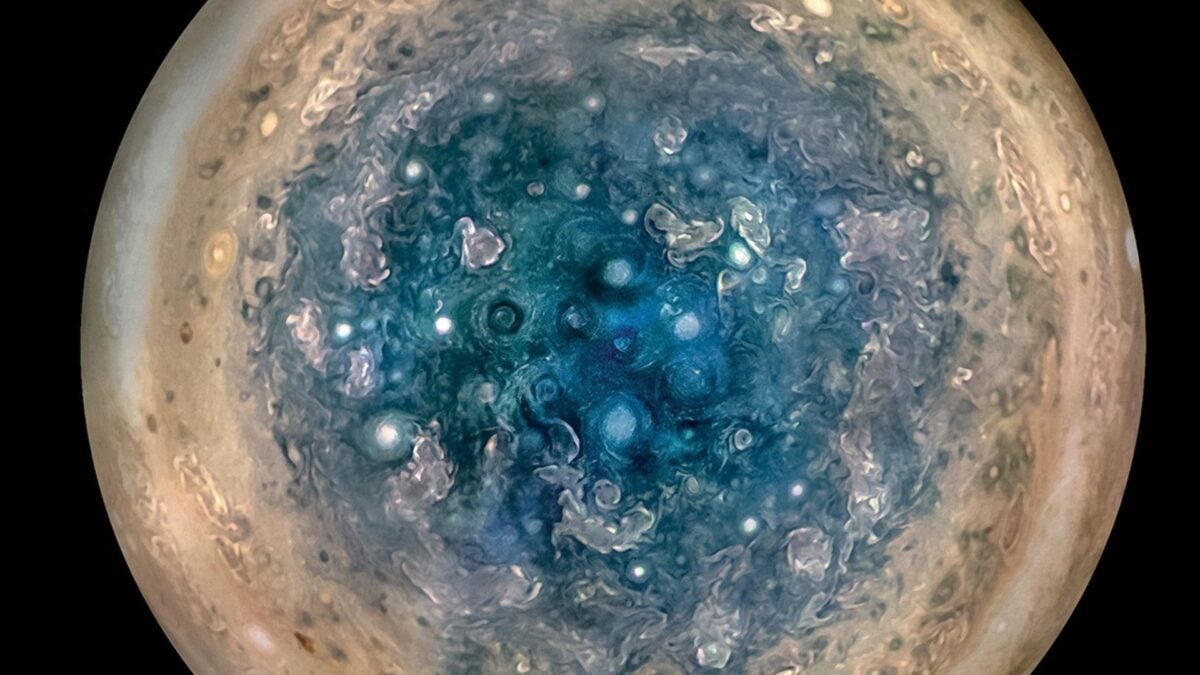
Since entering Jupiter’s orbit in 2016, NASA’s Juno spacecraft has been hard at work unveiling the many mysteries of our solar system’s largest planet. And its latest discovery may be one of the most intriguing yet: an entirely new type of plasma wave near Jupiter’s poles.
In a paper published Wednesday in Physical Review Letters, astronomers describe an unusual pattern of plasma waves in Jupiter’s magnetosphere—a magnetic “bubble” shielding the planet from external radiation. Jupiter’s exceptionally powerful magnetic field appears to be forcing two very different types of plasmas to jiggle in tandem, creating a unique flow of charged particles and atoms in its polar regions.
Plasma is a key force in shaping Jupiter’s turbulent atmosphere. As such, the researchers believe the new observations will further advance our understanding of not only Jupiter’s weather events but also the magnetic properties of distant exoplanets.

For the study, the researchers analyzed the behavior of plasma waves in Jupiter’s magnetosphere containing highly magnetized, low-density plasma. The team, a collaboration between researchers from the University of Minnesota, the University of Iowa, and the Southwest Research Institute, Texas, found an unexpected oscillation between Alfvén waves and Langmuir waves, which reflect the movement of the plasma’s atoms and the movement of the electrons in the plasma, respectively.
Electrons are much lighter than charged atoms, meaning that, normally, the two wave types ripple at very different frequencies—which was clearly not the case for Jupiter’s magnetosphere, prompting the researchers to take a closer look. The ensuing investigation unveiled a never-before-seen type of plasma oscillation near Jupiter’s poles.
“The observed plasma properties are really unusual, not found before and elsewhere in our solar system,” John Leif Jørgensen, a planetary scientist at the Technical University of Denmark who wasn’t involved in the new work, told New Scientist.
Unlike Earth’s auroras, which are caused by solar storms, Jupiter’s auroras—a barrage of frisky, superfast particles that are hundreds of times more energetic than auroras on Earth—sometimes emerge as a product of its powerful magnetic field. Getting a better grasp on how such phenomena work could be valuable information for future missions in the search for alien life on exoplanets, according to the study authors.
“While such conditions do not occur [on] Earth, it is possible that they apply in polar regions of the other giant planets and potentially in strongly magnetized exoplanets or stars,” the astronomers wrote in the paper.
“Jupiter is the Rosetta Stone of our solar system,” said Scott Bolton, Juno’s principal investigator, in NASA’s introductory page for the spacecraft. “Juno is going there as our emissary—to interpret what Jupiter has to say.”
Initially, NASA expected Juno’s mission to conclude in 2017, when they would intentionally steer the spacecraft into Jupiter’s atmosphere, a decision that adheres to NASA’s planetary protection requirements. But Juno’s flight path evolved over time, and NASA concluded that the spacecraft no longer posed a threat to Jupiter’s moons. As a result, the agency authorized extensions to the mission.
That being said, the scientists do believe that, by September this year, Juno’s orbit will degrade naturally, and it will be gobbled up by Jupiter’s atmosphere. However, this by no means ends humanity’s exploration of Jupiter; Europa Clipper is slated to reach Europa, Jupiter’s moon, in 2030 (the last time we checked, it did some sightseeing near Mars). Of course, even after Jupiter consumes Juno, scientists will still have loads of invaluable data from the spacecraft that they’ll continue to meticulously analyze for years to come.


 Language
 English
 VN
VN
 French
 Spanish
 Portuguese
 Deutsch
 Turkish
 Dutch
Dutch
 Italiano
 Russian
 Romaian
 Portuguese (Brazil)
 Arabic