


We Might Have Been Wrong About Where Spiders Came From
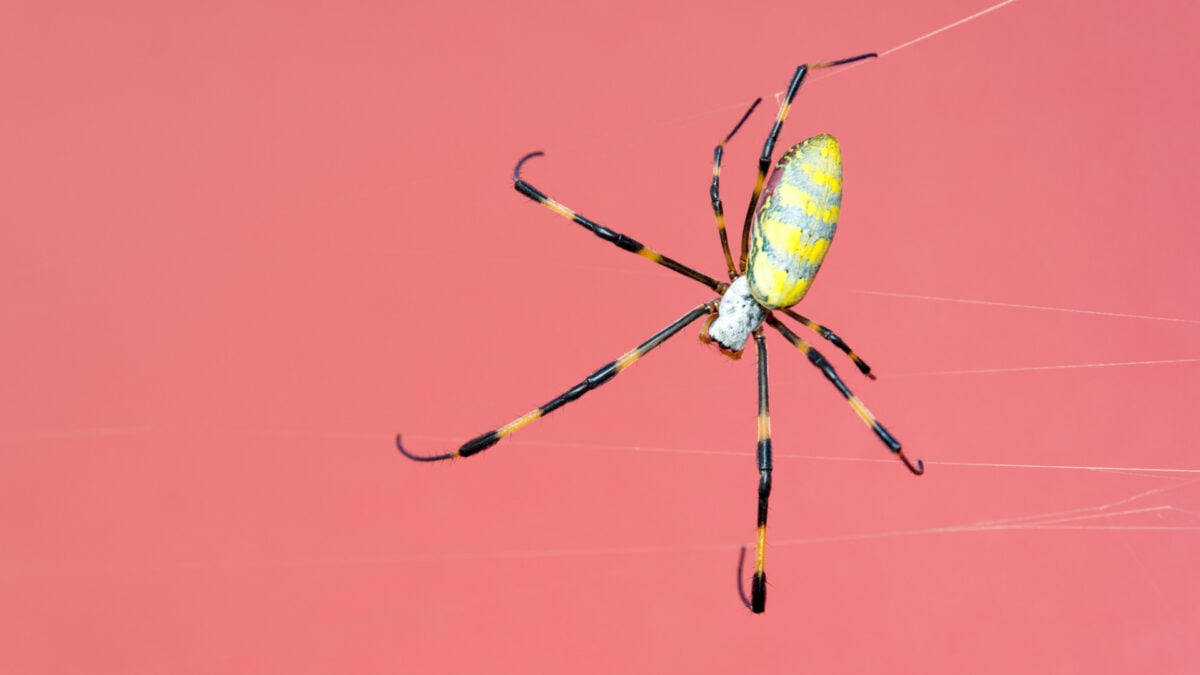
Technically speaking, every living thing on Earth can trace its origins to the sea. Some of these earliest creatures crawled onto land, evolving to become many different kinds of animals and insects—including, scientists believed for a long time, spiders and their relatives.
A new study published today in Current Biology challenges the popular conception that spiders first emerged on land, instead suggesting that these arachnids and their relatives originated and evolved in the ocean. The team reached this conclusion by investigating the fossilized central nervous system of Mollisonia symmetrica, a long-extinct animal from the Cambrian era (between 540 and 485 million years ago), thought to be the ancestor of horseshoe crabs. Mollisonia’s brain structure closely resembled that of modern spiders and their relatives, not their supposed crab descendants.

“The discovery of an arachnid brain in such an ancient creature as Mollisonia suggests that the major groups of arthropods alive today were already established then,” Nick Strausfeld, study lead author and neuroscientist at the University of Arizona, told Gizmodo in an email. He added that this “casts a fresh view on the question: Where did arachnids first evolve?”
Until now, scientists had assumed—based on the external features of arachnid-like fossils found in sedimentary rocks formed on land—that modern spiders and their relatives evolved on land. For the study, however, Strausfeld and his colleagues looked inside a well-preserved fossil of Mollisonia, which they did using an optical microscope and other imaging techniques to investigate its cerebral arrangements in higher detail.

The team uncovered several similarities between modern spiders and Mollisonia, but the most striking feature was that of the creatures’ central nervous system. Unlike insects, arachnid brains have a strange backward structure, in which the “forebrain lies on top of circuits that control the movement of the legs,” Strausfeld explained. It’s this that makes spiders and their relatives so “incredibly versatile in their movements.” As the new research shows, “the backward organization is enough of a ‘tell’ to demonstrate [that] Mollisonia‘s brain arrangement typifies those of living arachnids,” he said.
Other common features the team found included external resemblances, such as jointed limbs or pincer-like claws. They bolstered their hypotheses by running a statistical analysis comparing 115 anatomical traits across both living and extinct arthropods (which includes arachnids), which placed Mollisonia as a “sister” to modern arachnids, the authors reported in the study.

“This is very interesting, but we do not yet know how it relates to the vast array of arachnids other than spiders,” said Paul Selden, a paleontologist and arachnologist at the University of Kansas who wasn’t involved in the new work, in an email to Gizmodo. “Clearly, their conclusions on the phylogenetic [study of evolutionary history using visual cues] placement of Mollisonia are fascinating but merely mark the start of further investigation.”
It’s probably premature to declare spiders as spawns of the sea, but the good news is that Strausfeld and his colleagues already seem to be on the case.
“Most Cambrian fossils look very different from modern species, so it is really exciting when such outward appearances reveal something inside them—a fossilized brain and nervous system—that tells a different story,” Strausfeld said. “Arachnids are a crucial feature of our biosphere, and we should pay attention to what they contribute to our well-being.”


 Language
 English
 VN
VN
 French
 Spanish
 Portuguese
 Deutsch
 Turkish
 Dutch
Dutch
 Italiano
 Russian
 Romaian
 Portuguese (Brazil)
 Arabic