


Adorable Triassic Reptile Used its Freaky Back Fin to Communicate
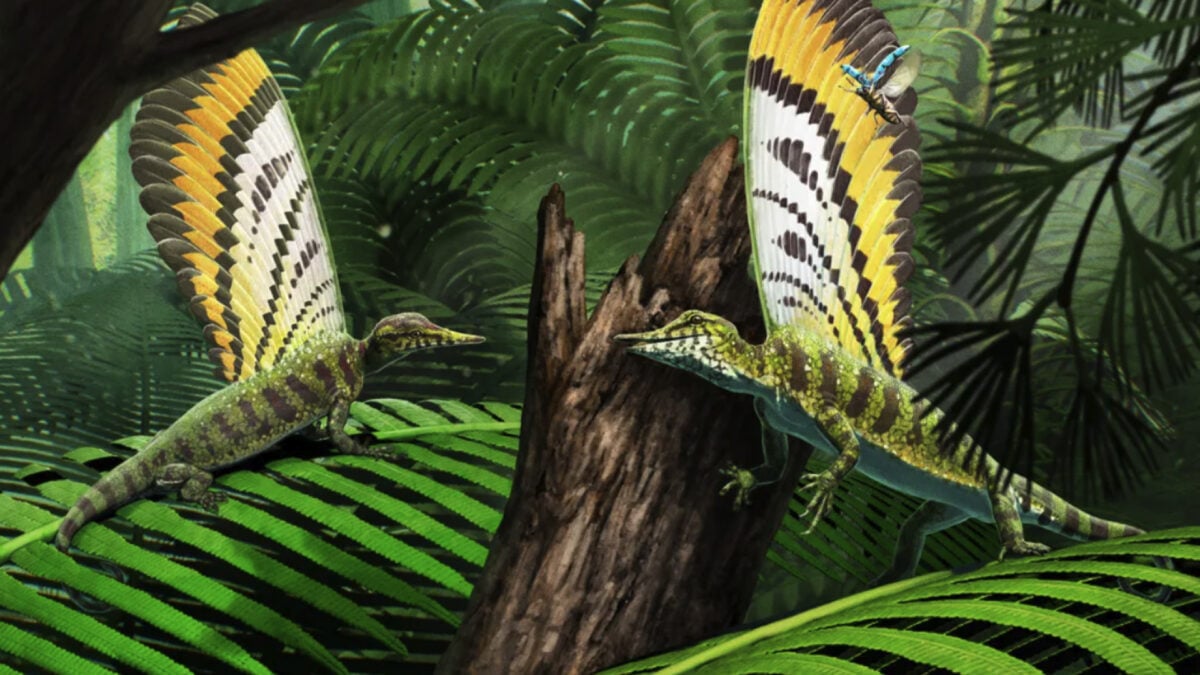
Technological advancements have brought us many things. For paleontologists, it’s introduced the ability to probe softer material—skin, feathers, scales, and hair—found on fossilized creatures. And that’s resulting in some strange new findings about long-extinct animals, showing us that they’re even weirder than we imagined.
A paper published today in Nature offers a re-analysis of a fossilized Mirasaura grauvogeli, a 247-million-year-old reptile whose defining feature is a feather-like structure jutting out from its back. The popular conception of these features is that the appendages were feathers, but the new study argues this isn’t the case. Rather, it’s an unusual type of skin that stretched out like a fan from the reptile’s back, the researchers argue. Further research is needed, but the study authors believe this fan likely served as a communication tool among the creatures.

These structures preserved pigment-carrying particles called melanosomes that are more bird-like than reptilian. But the curious thing about these appendages is that they were neither feathers nor scales. They’re “distinctly corrugated”—much like cardboard—and were likely malleable to some extent, the researchers report in the study.
“This evidence reveals that vertebrate skin has evolutionary possibilities that are weirder than might be easily imagined,” Richard Prum, an evolutionary biologist at Yale University who wasn’t involved in the new work, wrote in a commentary for Nature. “Mirasaura teaches us that a feather is only one of the many wondrous things that reptiles evolved to grow out of their skin.”

For the analysis, a team of paleontologists at Stuttgart’s State Museum of Natural History, Germany, revisited an old fossil of Mirasaura discovered in 1939 and acquired by the museum in 2019. Researchers were in the dark about what the fossil even was—in fact, the team behind the new study was the one that identified the creature for the first time.
Similarly, paleontologists weren’t able to fully understand Mirasaura’s close relative, Longisquama insignis, which also featured long, feather-like structures on its back. At the time, scientists weren’t sure what to make of it at all, partly because the Longisquama fossil wasn’t well preserved. For the new work, however, the team reconstructed the skeletal anatomy of the two creatures, finding it highly likely that Mirasaura and Longisquama were both part of the drepanosaur family, a strange group of reptiles from the Triassic era (between 201 million and 252 million years ago), sometimes referred to as “monkey lizards.”

And these drepanosaurs are as strange as they come: long, bird-like skulls, bodies like chameleons, and an anatomy that suggests they lived in trees. Should the new work be verified, it means that drepanosaurs may have sported elaborate, helical structures that extended out from their backs, like Mirasaura and Longisquama.
When studying the past, paleontologists use their best judgment to infer physical features based on the empirical evidence. So it’s even wilder that, using such careful and sophisticated methods, scientists essentially found a reptilian version of Transformers. At the same time, such “rediscoveries” of older fossils uncover amazing insights from the past—which is why we look forward to them each time.


 Language
 English
 VN
VN
 French
 Portuguese
 Deutsch
 Turkish
 Dutch
Dutch
 Italiano
 Russian
 Romaian
 Portuguese (Brazil)
 Greek
Greek
 Arabic