


An Even Scarier Predator Hunted Giant 'Terror Birds' in South America
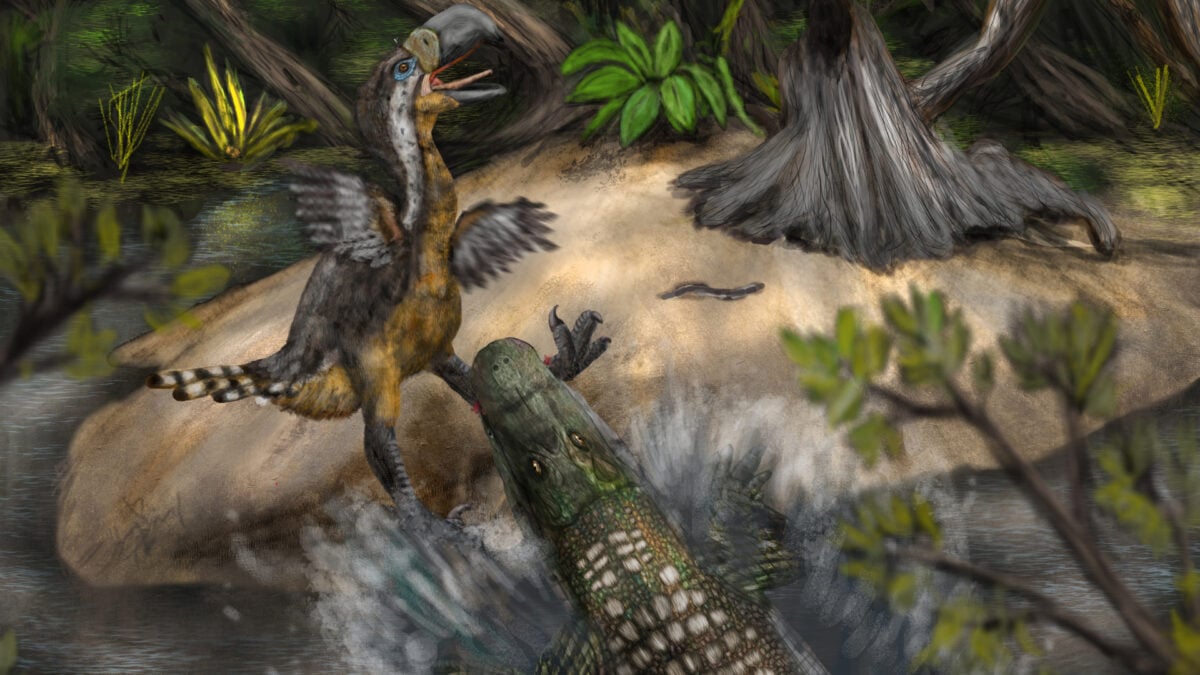
Sometime between 16 and 11.6 million years ago, a young caiman came upon a tasty snack in modern-day South America. The meal, however, turned out to be rather ambitious, because the croc hadn’t come upon just any old prey.
It was a phorusrhacid, a large carnivore in its own right, aptly known as a “terror bird.” The now-extinct terror bird wouldn’t have given in without a fight—unless, of course, it was already dead, and the opportunistic croc simply scavenged its dead body. That doesn’t seem to be the case, however. The meeting of the two apex predators played out, and all that’s left of it today is a handful of puncture wounds on a fossilized bone dating back to the Middle Miocene Epoch. For paleontologists, it’s offering rare insights into a prehistoric feeding interaction between two formidable but very different beasts.

“Evidence of direct trophic [feeding] interactions between apex predators remains as a topic that has been historically understudied,” researchers wrote in a study reconstructing the encounter, published Wednesday in the journal Biology Letters. “Prey is most often represented by herbivores and other animals that are not on the top of the trophic web,” i.e. non-apex predators, according to the study. This anecdotal account of an “aquatic apex predator feeding on a terrestrial apex predator” adds to our understanding of how complex food webs can be in both modern and ancient vertebrate ecosystems,” the scientists wrote.
To investigate the prehistoric showdown, the researchers scanned the previously identified terror bird fossil to create a digital model of the puncture wounds. They then turned the tooth marks into negatives to compare them to the teeth of crocodyliforms (a group of predatory reptiles including crocodiles, alligators, and caimans) from La Venta, the fossil hotspot in Colombia where the specimen originates.

“Comparisons with specimens of [modern] black caiman, Melanosuchus niger, suggest that the traces were likely inflicted by a large caimanine, between 4.6 and 4.8 m [15.1 to 17.7 feet] long,” explained the researchers, including University of the Andes’ biologist Andres Link. “In the current fossil assemblage of La Venta, the best match for a large caiman in this size range would be a juvenile or subadult specimen of the giant caimanine P. neivensis, the largest crocodyliform in the La Venta Fauna.”
Because the bite marks on the terror bird bone don’t show signs of healing, the bird likely did not survive the Purussaurus neivensis’ attack, or was already dead.
The study ultimately sheds light on an interaction between “some of the most emblematic apex predators in the Miocene of South America,” suggesting that large phorusrhacids may have had more to worry about than researchers previously thought.


 Language
 English
 VN
VN
 French
 Spanish
 Portuguese
 Deutsch
 Turkish
 Dutch
Dutch
 Italiano
 Russian
 Romaian
 Portuguese (Brazil)
 Arabic