


‘’Without AI, Q Fever Might Not Have Been on Our List"
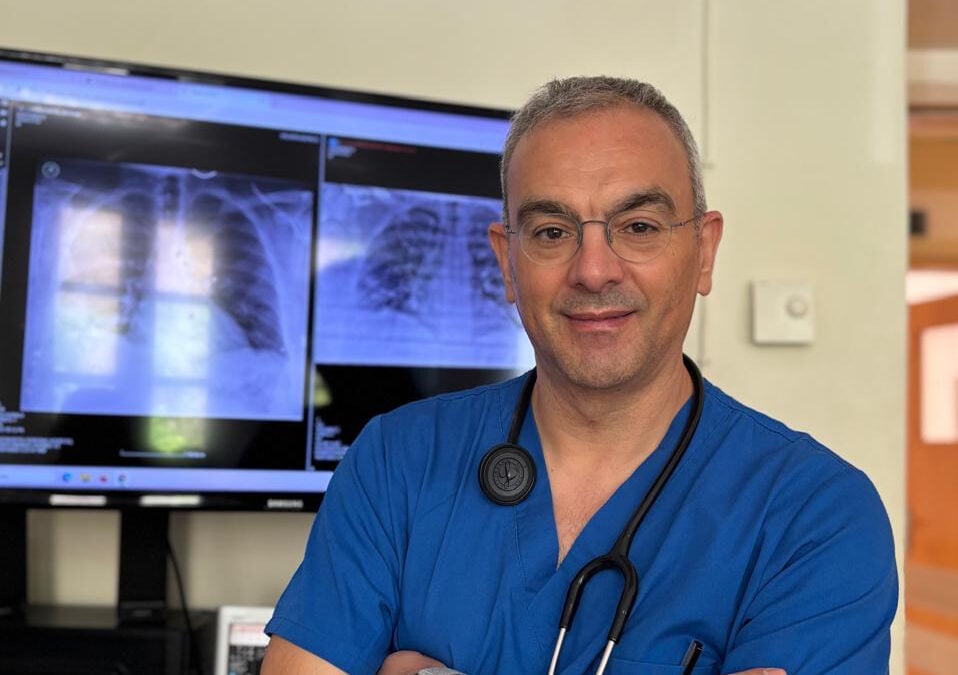
Ioannina, a lakeside town in northern Greece surrounded by mountains, is not the kind of place you expect to find cutting-edge artificial intelligence quietly reshaping medicine. Yet, inside its main public hospital, Dr. Tzimas is doing just that.
Dr. Tzimas is quietly reshaping how medicine is practiced. From spotting rare diseases like Q fever to managing conflicts among junior doctors, Dr. Tzimas has woven AI into the rhythm of daily medical life.
However, he believes that AI will not be able to replace the essential human interactions that are at the heart of his work. “You have to listen to lung sounds, palpate the abdomen, look patients into their eyes,” he says. “AI can’t feel pain responses or smell signs of illness.”
Dr. Tzimas is the director of the Internal Medicine Department at General Hospital of Ioannina “G. Hatzikosta.”
This interview is part of our series How Do You Use AI, where we ask people one simple question: How do you use AI? No TED Talk nonsense, just real life.
Episode 3: Dr. Thomas Tzimas—AI Pragmatist.
Gizmodo: How does AI fit into your daily medical practice?
Dr. Tzimas: AI acts as an assistant that helps us work faster and more reliably. We feed it solid data, review the output, and proceed if it’s okay. This is particularly helpful when we need to respond to insurance companies about a patient’s situation or send emails to family physicians.
Gizmodo: Can you give a specific example of how AI assists with patient care?
Dr. Tzimas: One major area is drug interactions. There are extensive tables of drug interactions, but they’re difficult to access quickly when you’re with a patient. AI systems can provide this information very easily and without mistakes. It also helps with adjusting dosages for patients with conditions like renal insufficiency or hepatic failure, where normal doses might be harmful.
Gizmodo: Are you concerned about AI “hallucinations” or inaccuracies in the medical field?
Dr. Tzimas: An experienced clinician can spot hallucinations right away. If you prompt the AI with very strict protocols, they do not hallucinate. The “temperature” setting of AI models is crucial; for the medical field, it needs to be set to 0.3, which makes them very strict and prevents them from fantasizing or hallucinating. Normal AI systems often have a temperature of 1, which leads to a lot of fantasizing and hallucinating.
Gizmodo: Do you use AI for personal matters?
Dr. Tzimas: I use AI for almost all my emails, especially within the communication platform among doctors. I use a “negotiator GPT” prompt that makes answers very diplomatic. This is particularly useful when there’s a conflict among junior doctors, as I have to maintain integrity and prevent conflicts while still being strict. It helps me reply in a way that smooths over potential issues, like an accomplished diplomat would.
Gizmodo: Interesting…
Dr. Tzimas: I also use AI to create teaching materials very quickly. For instance, I can take a complex clinical case from a journal like the New England Journal of Medicine and ask the system to create multiple-choice questions from it. I then present these questions to the doctors, and I can see who answers correctly or incorrectly. The next day, I provided the correct answer. AI also helps me summarize large articles and complex medical cases from journals for easier discussion. This has freed up a lot of my time.
Gizmodo: Does AI assist with diagnosis?
Dr. Tzimas: AI tools are really capable for differential diagnosis. If a patient presents with a symptom like fever, it could be a thousand things. With AI, we can narrow down the possibilities to less than 10, and then through clinical examination, imaging, and consultations, we narrow it down to one. The system can even remind you of really rare conditions that might be happening to your patient.
Gizmodo: When was the last time AI helped you in a case?
Dr. Tzimas: A few hours ago, we completed a difficult case. One patient, a labor worker, had inhaled a lot of dust in a sheep and goat stable and came in with a fever. We used AI to consider what diseases could be contracted from dust in such a stable. One of the highly-ranked differential diagnoses was Q fever, which is very rare. We sent a blood sample to Athens to exclude it. Although it came back negative and the final diagnosis was unrelated, the AI system identified Q fever as a potential possibility, which opened our horizons. Without AI, Q fever might not have even on our list.
Gizmodo: Do your patients use AI themselves?
Dr. Tzimas: Yes, some patients now use AI, similar to how they used to Google their symptoms. They might come in saying, “This is what ChatGPT said,” and we have to respond to that. As AI spreads, people with health questions will use it to get analyses of their symptoms. Our job as doctors remains the same: to professionally answer questions and provide credible answers and solutions. This means doctors also need to use AI for support, paperwork, and even creating dietary plans for patients.
Gizomo: Does AI replace the need for administrative staff, like a personal assistant?
Dr. Tzimas: It reduces the need. For example, my previous boss would write notes on paper for his assistant to type. Now, I dictate notes on my iPhone, copy-paste them into an AI system, and it creates a nice email. Also, I can take pictures of paper documents, and AI can transcribe them into a digital form, saving tons of time and creating digital archives.
Gizmodo: Are you worried about AI replacing you?
Dr. Tzimas: No, not at all. My job involves experience that AI cannot yet replicate. I need to listen to lung, heart, and bowel sounds, palpate patients, and inspect them. While AI might analyze a digital photograph of a skin lesion, it cannot palpate a patient and feel the intensity of pain or guarding. These are qualities that rely on a doctor’s senses, like smelling a patient’s breath to detect diabetic ketoacidosis. Human interaction, like looking a patient in the eyes, observing their demeanor, and assessing their hygiene, provides crucial information that AI cannot easily replace. AI helps save time, but it needs an experienced physician to input those essential details.
Gizmodo: How does AI affect your work-life balance?
Dr. Tzimas: It saves time. Preparing teaching material used to take me hours; now I just spend an hour or a couple of hours and I’m ready. So I have more time for my personal life.


 Language
 English
 VN
VN
 French
 Spanish
 Portuguese
 Turkish
 Dutch
Dutch
 Italiano
 Russian
 Romaian
 Portuguese (Brazil)
 Greek
Greek
 Arabic