


Astronomers Discover the Earliest Black Hole Ever Confirmed
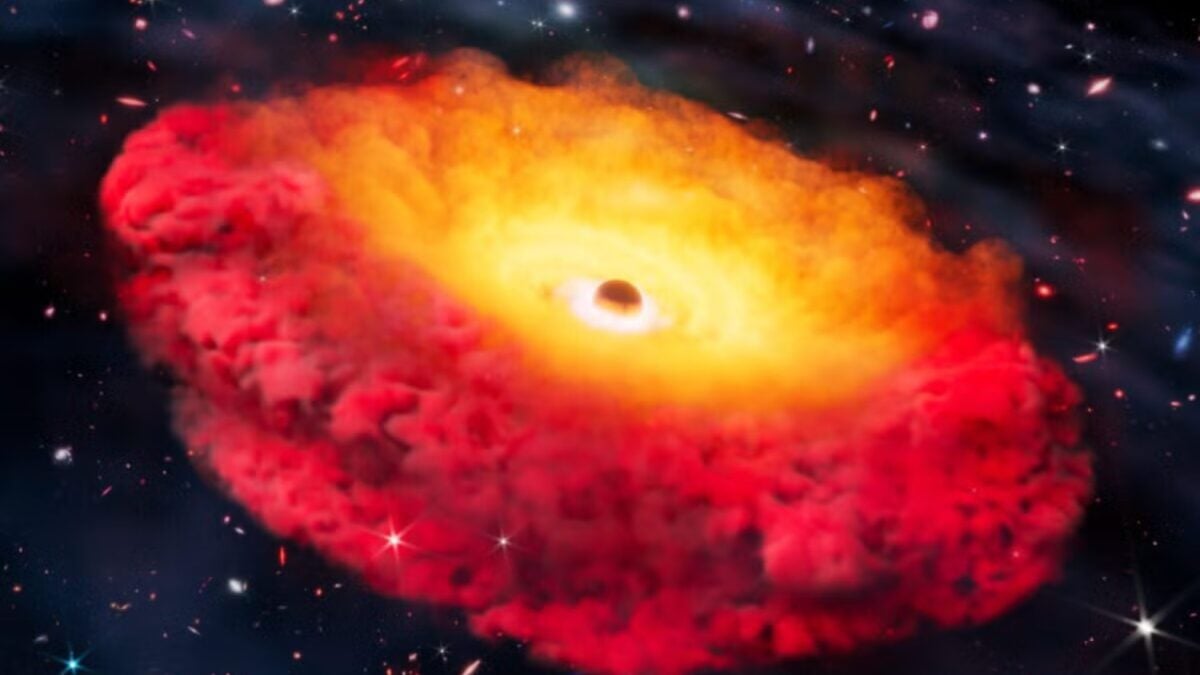
An international team of astronomers has identified the earliest black hole ever confirmed, an ancient behemoth that existed just 500 million years after the Big Bang. The discovery could offer new clues to a mysterious class of ancient galaxies that confounded prevailing theories of cosmology.
In a new paper published in The Astrophysical Journal Letters, the researchers describe CAPERS-LRD-z9—a distant, gas-enshrouded galaxy with a supermassive black hole at its center. It dates back some 13.3 billion years, a point when the universe was just 3% of its current age. Spotted by the James Webb Space Telescope, CAPERS-LRD-z9 is one of many “little red dot” galaxies—these strange bodies began popping up in Webb imagery within the first year of the telescope’s mission.
“The discovery of Little Red Dots was a major surprise from early JWST data, as they looked nothing like galaxies seen with the Hubble Space Telescope,” Steven Finkelstein, co-author of the new study and director of the Cosmic Frontier Center at the University of Texas at Austin, said in a press release. “Now, we’re in the process of figuring out what they’re like and how they came to be.”
Little red dot galaxies are named for their scarlet pinprick appearance in Webb’s images, and no telescope prior to Webb has had the sensitivity or resolution to detect such distant objects—hence why no one had seen them before. Their discovery threw consensus ideas about our universe into question: If these objects were stars, their strong light emissions would imply that some galaxies had grown so big and so fast that prevailing theory couldn’t account for them, according to NASA.
Finkelstein and his colleagues compiled one of the largest samples of litte red dot galaxies to date, nearly all of which existed during the first 1.5 billion years after the Big Bang. That study, published in January, found a significant number of these objects likely contained growing supermassive black holes. The finding offered an alternative explanation for how much light the galaxies emit, but they needed more evidence to support their theory.
So Finkelstein and a team led by Anthony Taylor, a postdoctoral researcher at the Cosmic Frontier Center who also worked on the research published in January, sifted through spectroscopy data from Webb’s CAPERS (CANDELS-Area Prism Epoch of Reionization Survey) program. Spectroscopy measures different wavelengths of light to reveal details about an object’s characteristics.
When black holes interact with surrounding gas clouds, it produces a distinct spectroscopic signature: As gas rapidly swirls around and falls into a black hole, light from gas that is moving away from us stretches into redder wavelengths, while light from gas that is moving toward us compresses into bluer wavelengths.
“There aren’t many other things that create this signature,” Taylor said, and CAPERS-LRD-z9 has it. The discovery marks the first time astronomers have found this spectroscopic signature associated with a little red dot galaxy, according to the team, indicating that supermassive black holes are the likely source of their unexplained brightness. The work could also help explain what makes these galaxies so red: If light is passing through a thick cloud of gas around a supermassive blackhole, it would stretch into redder wavelengths.
“We’ve seen these clouds in other galaxies,” Taylor said. “When we compared this object to those other sources, it was a dead ringer.”
The discovery could also offer fresh insights into black hole evolution. Taylor and his colleagues estimate that the black hole at the center of this galaxy is enormous—up to 300 million times more massive than the Sun. Finding a black hole of this size that existed so early on in the universe “adds to growing evidence that early black holes grew much faster than we thought possible,” Finkelstein said. “Or they started out far more massive than our models predict.”


 Language
 English
 VN
VN
 French
 Spanish
 Portuguese
 Deutsch
 Turkish
 Dutch
Dutch
 Italiano
 Russian
 Romaian
 Greek
Greek
 Arabic