


Stunning New Image Reveals the Birth of a Twin Solar System
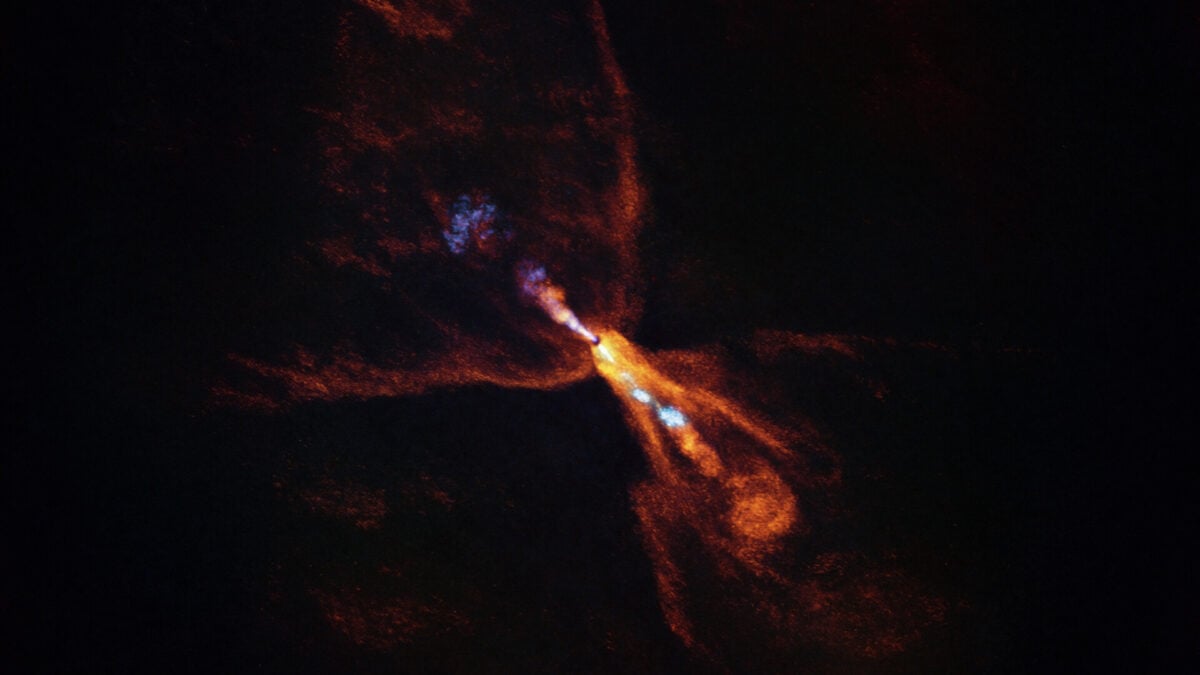
The first-ever baby pictures of a solar system that’s not our own are finally here—and they’re beautiful—and as adorable as space entities can get.
In a paper published today in Nature, astronomers presented HOPS-315: a Sun-like protostar cooking up a brew of hot minerals and silicon monoxide gas, located about 1,300 light-years away from Earth. The special thing about HOPS-315 is that the baby star and its surrounding environment bear a striking resemblance to an earlier version of our own solar system, making it the quintessential candidate for astronomers hoping to better understand how our Solar System came to be.
[embed]https://www.youtube.com/watch?v=0j-MH6_QlBA[/embed]
For study lead author Melissa McClure, the most intriguing aspect of HOPS-315 is its protoplanetary disk, or the stormy region around a newborn star where planets are born, she told Gizmodo in a video call. Astronomers have already observed protoplanetary disks by the hundreds, some of which even have (gassy) planets. But none have been as young, robust, and filled with planet-forming compounds as the one encircling HOPS-315, McClure, an astronomer at Leiden University in the Netherlands, told Gizmodo in a video call.
McClure and her team analyzed data on nearly 3,000 protostars gathered by the now-retired Spitzer Space Telescope. Most of them were too old—“like, at least a million years, maybe five million years old”—and only had enormous gas giants floating in their vicinity, she said. On the other hand, stars that did fit the “age requirement,” so to speak, were enveloped by a thick, cold molecular cloud concealing their stormy insides from view.
Of the thousands of stars they sifted through, HOPS-315—about 100,000 years old—happened to be positioned at an angle that allowed the team to get a rare peek past the thick, gassy barrier. Using a combination of the James Webb Space Telescope (JWST) and the Atacama Large Millimeter/submillimeter Array (ALMA), they singled out what McClure described as “wiggly, hairy-looking” signatures of chemical compounds strongly correlated with early planet formation.
One of those, silicon monoxide, according to McClure, was a “clear smoking gun for interstellar grains” that evolve to become planets, so she knew they’d struck on something meaningful.

“And we also saw these hot minerals in the same part from JWST, so we could put these two things together and say we’re clearly seeing this ‘t=0’ moment for the first time,” McClure said. “HOPS-315 is very similar, in terms of mass, size, and the age we’re seeing it at, to what the Sun would have looked like [earlier on]. Because of that, it’s like an analog to the Sun—that’s why we’re saying we’re seeing another solar system being formed.”
Looking ahead, McClure’s team plans to conduct a deeper dive into these signals, some of which didn’t quite match what theoretical models would have predicted for similar situations, she noted. In particular, HOPS-315 offers an extremely rare opportunity to study planetesimals—hard fragments of loose cosmic mass that eventually bunch up to form the more solid parts of a planet.
Because they’re so ephemeral and just generally very tiny, the only way astronomers could study planetesimals was by indirectly tracking their formation through meteorite samples—until now, that is.
“We’re actually seeing right now that these planetesimals are actively forming,” McClure said. “And we’re absolutely going to follow that up—and this would be a cool new way to access [our galaxy’s origins] that you can’t do in any other way.”
A fair number of recent discoveries in astronomy have come from revisiting previously observed objects using newer, more advanced instruments. In this case, astronomers used JWST and ALMA to supplement pre-existing Spitzer data. A similar example is Herbig-Haro 49/50, or the “Cosmic Tornado.” Astronomers initially observed this steaming pillar of space dust—the product of fierce plasma jets from protostars—with Spitzer in 2006. Almost 20 years later, JWST captured the same object but in much finer resolution, revealing details that weren’t so clear back then.

This, in part, is evidently thanks to the continuous advances in observational technology. But it’s also the product of the grueling tenacity of astrophysicists who refuse to forget about the pressing mysteries surrounding the universe, no matter how dated they may be.
So, HOPS-315, as with many discoveries in astrophysics, is a testament to just how long certain findings can take—the reason why, perhaps, the answers we finally arrive at feel ever more rewarding, illuminating, and, of course, beautiful!


 Language
 English
 VN
VN
 French
 Spanish
 Portuguese
 Deutsch
 Turkish
 Dutch
Dutch
 Italiano
 Russian
 Romaian
 Portuguese (Brazil)
 Arabic